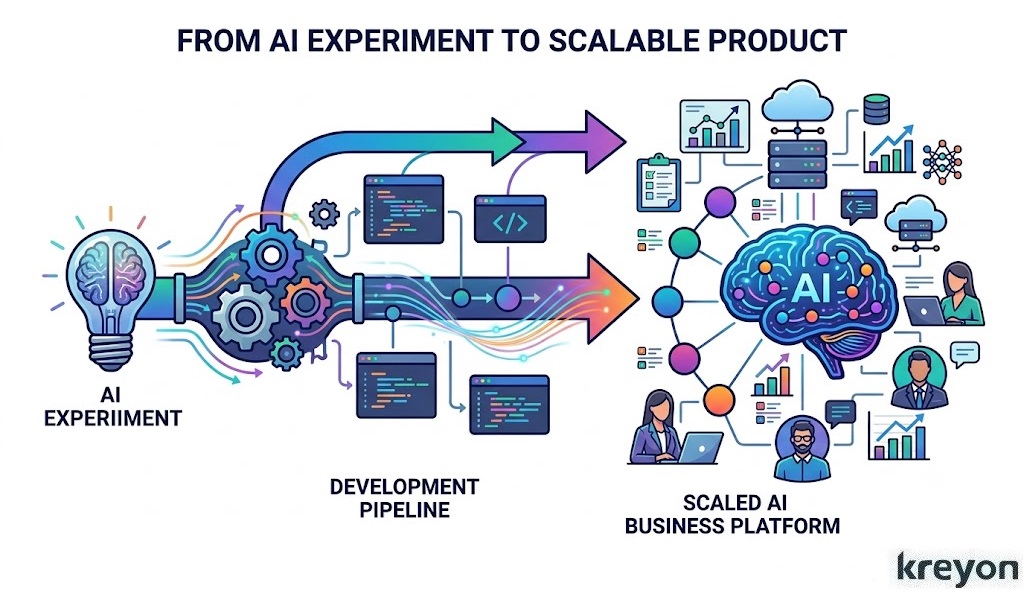
 Every technology revolution begins with a moment of excitement!
The internet created a new way to connect businesses and customers. Cloud computing changed how companies built and operated software. Mobile transformed how people interacted with brands.
Artificial intelligence is creating a similar shift.
But unlike previous technology waves, AI is not simply changing the tools businesses use. It is changing how businesses make decisions, serve customers, automate operations, and create new products.
Every organization today is asking the same question:
“How do we turn artificial intelligence into real business value?”
The answer is not another AI experiment.
The answer is AI Product Management.
AI Product Management is becoming one of the most important capabilities for organizations that want to successfully move from AI curiosity to AI transformation.
It provides the discipline needed to identify valuable opportunities, design trustworthy AI experiences, build scalable systems, & measure business impact.
The companies that succeed with AI will not necessarily be the ones with the largest technology budgets or the most advanced models.
They will be the ones that understand how to transform AI capabilities into products people trust and businesses can scale.
The AI Experimentation Era Is Ending
Over the last few years, organizations have rapidly experimented with artificial intelligence.
Executives have launched AI innovation labs. Engineering teams have built prototypes. Employees have tested AI assistants. Companies have integrated large language models into existing applications.
The speed of innovation has been remarkable.
However, a new challenge is emerging.
Many organizations have successfully demonstrated that AI can work.
Far fewer have successfully demonstrated that AI can create lasting business value.
This distinction matters.
A prototype can impress stakeholders during a presentation.
A product must survive real-world complexity.
A successful AI product must answer difficult questions:
Will customers actually use it?
Will employees trust its recommendations?
Can it integrate with existing systems?
Can it handle enterprise-level security requirements?
Can leadership measure the return on investment?
The gap between an impressive AI demonstration and a successful AI product is where AI Product Management becomes essential.
What Is AI Product Management?
Traditional product management focuses on solving customer problems through technology.
AI Product Management expands this responsibility by adding new dimensions:
Data strategy
Model performance
AI ethics
Human-AI interaction
Continuous learning
Trust and transparency
An AI product is fundamentally different from traditional software.
Traditional software follows predefined rules.
AI products learn from information, identify patterns, generate recommendations, and continuously evolve.
This creates enormous possibilities—but also introduces complexity.
Consider a traditional accounting application.
A rule-based system might follow a simple workflow:
“Approve invoices below a certain threshold.”
An AI-powered finance product can do much more:
Analyze historical payments
Detect unusual transactions
Predict approval risks
Identify duplicate invoices
Recommend actions to finance teams
The technology creates possibilities
But the product management challenge is deciding:
Where should AI be applied to create meaningful business outcomes?
The Biggest Mistake Companies Make: Starting With AI Instead of Problems
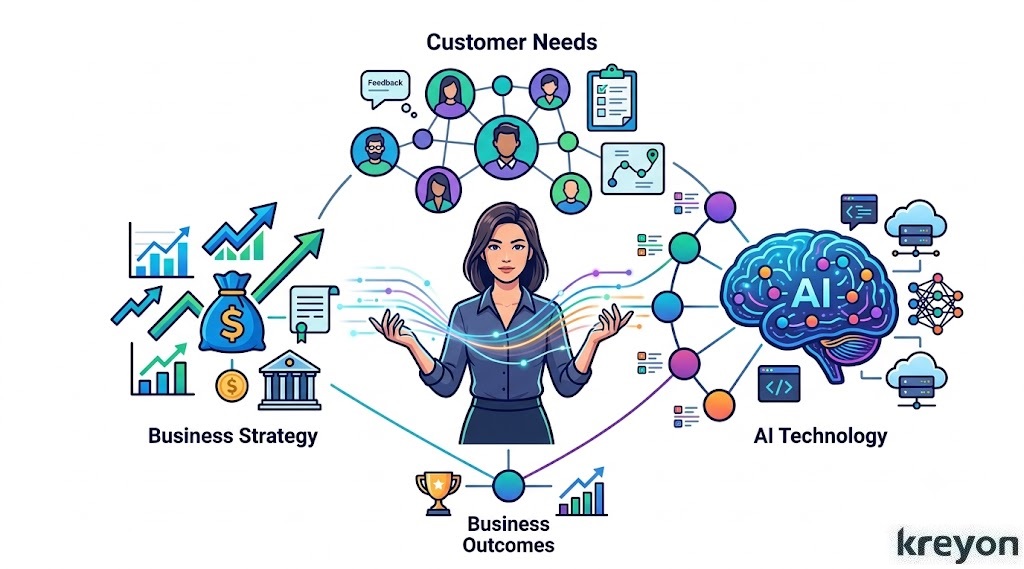
One of the most common mistakes organizations make is beginning with technology.
The conversation often starts like this:
“We should build something with generative AI.”
“We need an AI chatbot.”
“We need an AI assistant.”
These statements describe capabilities, not outcomes.
Successful AI Product Management begins differently.
It starts by asking:
“What important business problem can AI solve better than existing approaches?”
A healthcare organization does not need AI because AI is interesting.
It needs AI because:
Administrative processes consume too much time.
Healthcare professionals need better access to information.
Patients expect faster service.
A finance organization does not need AI because competitors are using it.
It needs AI because:
Manual processes slow decision-making.
Reporting takes too long.
Teams spend valuable time on repetitive tasks.
AI is not the destination.
Business improvement is the destination.
Why Many AI Products Fail Before They Reach Scale
The technology industry has learned an important lesson:
Building an AI prototype is relatively easy.
Building an AI product that delivers measurable business results is much harder.
Several patterns repeatedly appear in unsuccessful AI initiatives.
1. Building Impressive Technology Without a Clear Business Case
Many AI projects begin because a team discovers an exciting technical capability.
A new model becomes available.
A new AI framework launches.
A competitor announces an AI initiative.
The organization reacts by asking:
“How can we use this technology?”
A stronger approach is:
“Which business process creates the greatest opportunity for improvement?”
The difference may appear subtle, but it changes the entire product strategy.
For example:
A company may decide to build an AI customer service assistant.
The technology team focuses on:
Natural language processing
Model selection
Response generation
But the business team cares about:
Reducing customer wait times
Improving satisfaction scores
Increasing support team productivity
The AI product succeeds only when both perspectives are aligned.
2. Ignoring User Adoption
A technically successful AI product can still fail if people do not use it.
Why?
Because AI changes how people work.
Employees may worry:
Will AI replace my role?
Can I trust these recommendations?
What happens if the AI makes a mistake?
Will this make my job harder?
Successful AI products are designed around human behavior.
The goal is not simply automation.
The goal is augmentation.
The best AI products help people become more effective.
For example:
A financial analyst does not necessarily need AI to make every financial decision.
They need AI to help them:
Find important trends faster.
Identify potential risks.
Analyze large amounts of information.
Generate insights.
The AI becomes a trusted partner rather than a replacement.
3. Treating Data as an Afterthought
Every successful AI product depends on one critical foundation:
Data.
Many organizations focus heavily on selecting the right AI model while underestimating the importance of data quality.
Poor data creates poor AI outcomes.
Common challenges include:
Incomplete information
Data stored across disconnected systems
Outdated records
Lack of ownership
Security concerns
An AI system cannot deliver reliable business recommendations if it does not have access to reliable business information.
This is why successful AI Product Management includes data strategy from the beginning.
4. Designing AI Without Trust
Trust is becoming the defining factor in AI adoption.
People are willing to use AI when they understand:
What it does.
How it makes decisions.
When human review is required.
How their information is protected.
Imagine an AI system that recommends approving a large financial transaction.
A user will naturally ask:
“Why did the AI recommend this?”
A trustworthy AI product provides context:
Relevant transaction history
Supporting evidence
Confidence score
Explanation of recommendation
Trust is not a feature added at the end. It is a foundation of AI product design.
AI Product Management
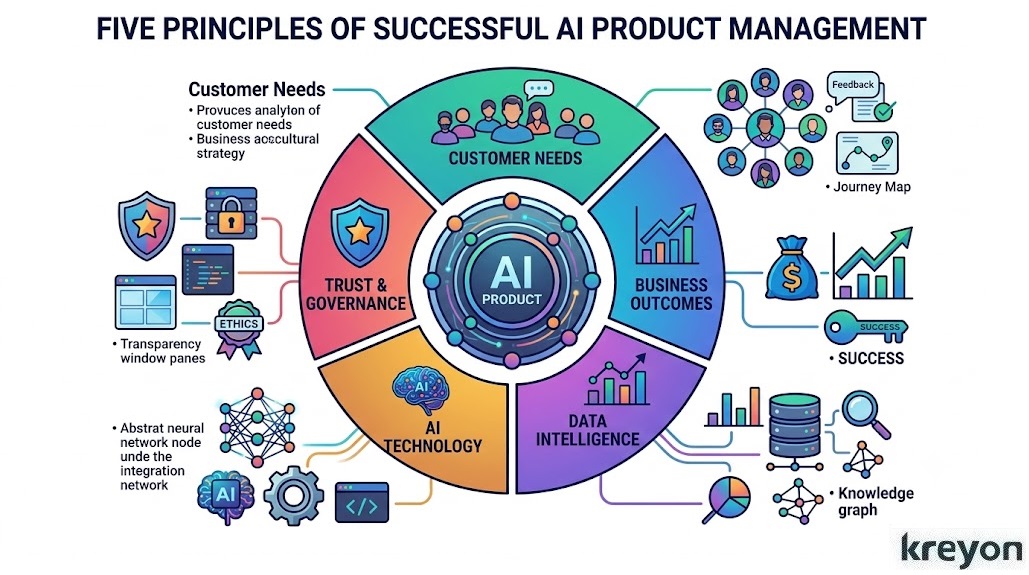
Building successful AI products requires a different mindset from traditional software development.
The following principles help organizations move from experimentation to scalable value.
Principle 1: Define Business Outcomes Before Building Features
The strongest AI products begin with measurable goals.
Instead of saying:
“We want an AI-powered finance assistant.”
Define:
“We want to reduce month-end reporting effort by 50%.”
Instead of:
“We want AI automation.”
Define:
“We want to reduce manual document processing time from five days to one day.”
Clear outcomes create alignment between:
Business leaders
Product managers
Engineers
End users
Every AI capability should connect to a measurable improvement.
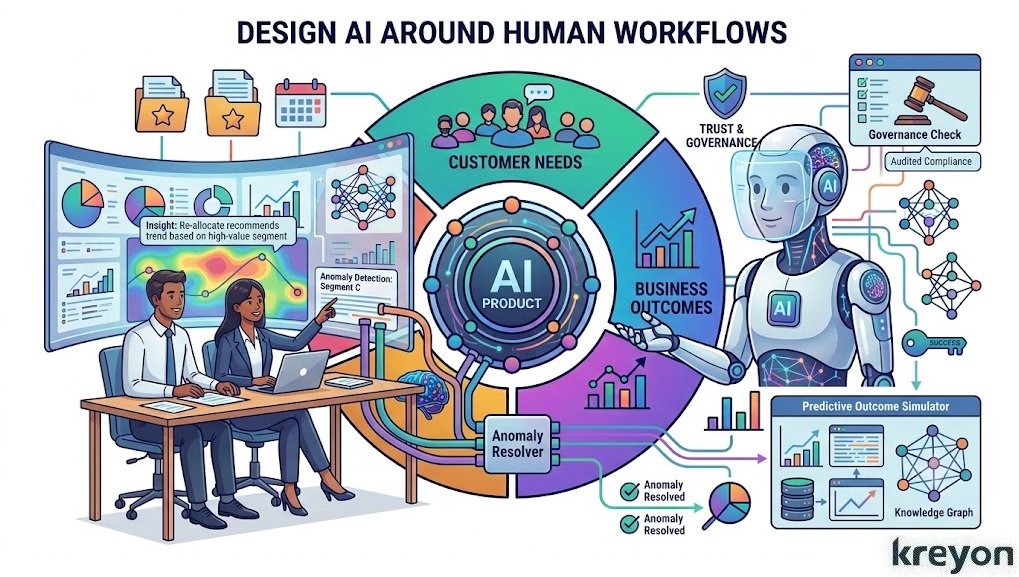
Principle 2: Build Around Real Human Workflows
The most valuable AI products fit naturally into existing processes.
A common mistake is asking users to change their entire workflow to accommodate AI.
The better approach is integrating AI into the way people already work.
For example:
A sales team does not need another dashboard showing AI insights.
They need AI integrated into their CRM workflow:
Identify high-potential leads.
Suggest personalized outreach.
Summarize customer conversations.
Recommend next actions.
The closer AI is to daily work, the higher the adoption.
Principle 3: Design for Continuous Improvement
AI products are never truly finished.
Traditional software may be updated periodically.
AI products require continuous learning.
Organizations must monitor:
User feedback
Model performance
Accuracy
Business outcomes
Changing requirements
The best AI products improve every time users interact with them.
Principle 4: Build AI Products That Integrate With Business Ecosystems
A common misconception about AI products is that intelligence alone creates value.
It does not.
Intelligence becomes valuable when it connects with the systems, workflows, and decisions that drive the business.
A standalone AI application may generate impressive responses, but enterprise value comes when AI becomes part of everyday operations.
Consider a finance organization.
A generic AI assistant can answer questions about accounting concepts.
But an integrated AI finance platform can:
Pull data from accounting systems.
Analyze transaction patterns.
Identify exceptions.
Recommend actions.
Trigger approval workflows.
Generate financial insights.
The difference is integration.
The future of enterprise AI will not be defined by isolated AI tools. It will be defined by intelligent systems connected across the organization.
This is why modern AI Product Management requires product leaders to think beyond features.
They must understand:
Existing technology ecosystems.
Business processes.
Data flows.
User behavior.
Operational constraints.
The best AI products disappear into workflows.
Users do not think:
“I am using artificial intelligence.”
They think:
“This process has become easier.”
Principle 5: Measure AI Success Through Business Outcomes
One of the biggest mistakes organizations make is measuring AI success through technical metrics alone.
Model accuracy matters.
Response speed matters.
System reliability matters.
But executives ultimately care about business impact.
A successful AI product should answer:
Did we reduce operational costs?
Did we improve customer experience?
Did we increase employee productivity?
Did we create new revenue opportunities?
Did we improve decision-making?
For example, an AI customer service assistant should not only report:
“Handled 100,000 conversations.”
The more important questions are:
Did resolution time decrease?
Did customer satisfaction improve?
Did support teams become more productive?
Did customer retention increase?
AI Product Management creates the connection between technology performance and business performance.
Case Study: Building an AI-Powered Finance Operations Platform
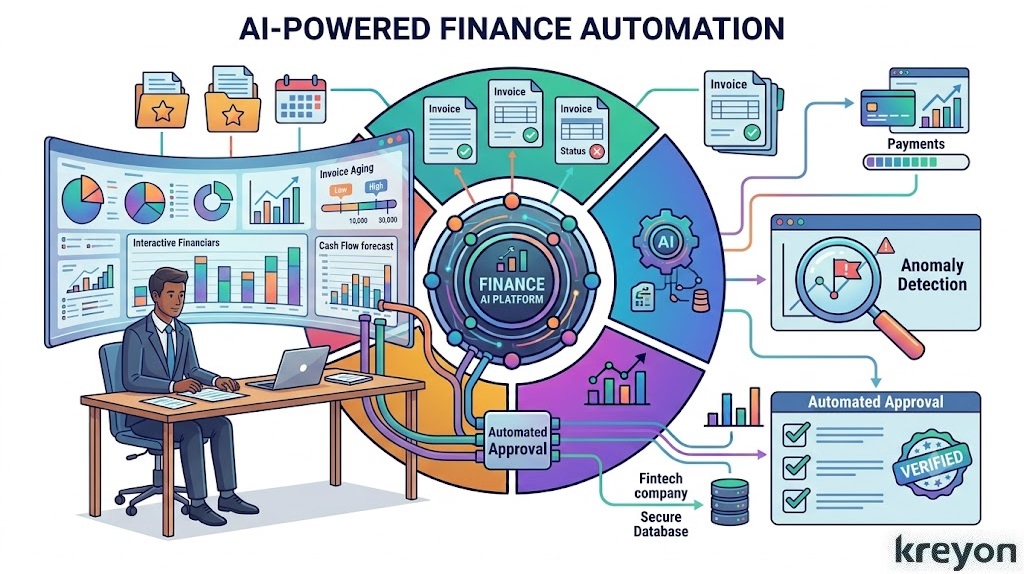
Turning Manual Financial Processes Into Intelligent Business Workflows
A growing organization faced a challenge familiar to many mid-sized businesses.
As revenue increased and operations expanded, the finance team found itself spending more time managing processes and less time providing strategic insights.
The organization relied on a combination of:
Spreadsheets
Manual approvals
Email-based workflows
Multiple disconnected systems
These processes created several challenges:
Slow invoice processing
Longer reconciliation cycles
Limited visibility into financial trends
Increased possibility of human errors
High dependence on manual effort
The company recognized that simply adding more employees would not solve the problem.
It needed a smarter approach.
The objective was not just automation.
The objective was building an intelligent finance operating system.
Identifying the Right AI Opportunities
The first step was not selecting an AI model.
It was understanding where AI could create meaningful business value.
Through process analysis, several high-impact opportunities were identified.
AI-Powered Invoice Processing
Invoice management involved repetitive manual activities:
Reading invoice documents
Extracting information
Checking purchase orders
Routing approvals
Identifying exceptions
An AI-powered workflow could:
Extract invoice data automatically.
Match invoices against business records.
Detect unusual patterns.
Recommend approval decisions.
The finance team could spend less time processing documents and more time managing financial performance.
Intelligent Reconciliation
Financial reconciliation is often time-consuming because teams must compare information across multiple sources.
AI could assist by:
Identifying matching transactions.
Highlighting discrepancies.
Prioritizing exceptions.
Learning from previous decisions.
Instead of reviewing every transaction manually, finance professionals could focus on situations requiring judgment.
AI Financial Assistant for Business Leaders
Executives often need quick answers:
“Which customers have delayed payments?”
“Why did expenses increase this quarter?”
“Which areas have cost-saving opportunities?”
Traditionally, answering these questions required:
Data extraction
Spreadsheet analysis
Manual reporting
An AI-powered financial assistant could provide insights within minutes.
This changes the role of finance teams.
They move from reporting historical information to helping leaders make better decisions.
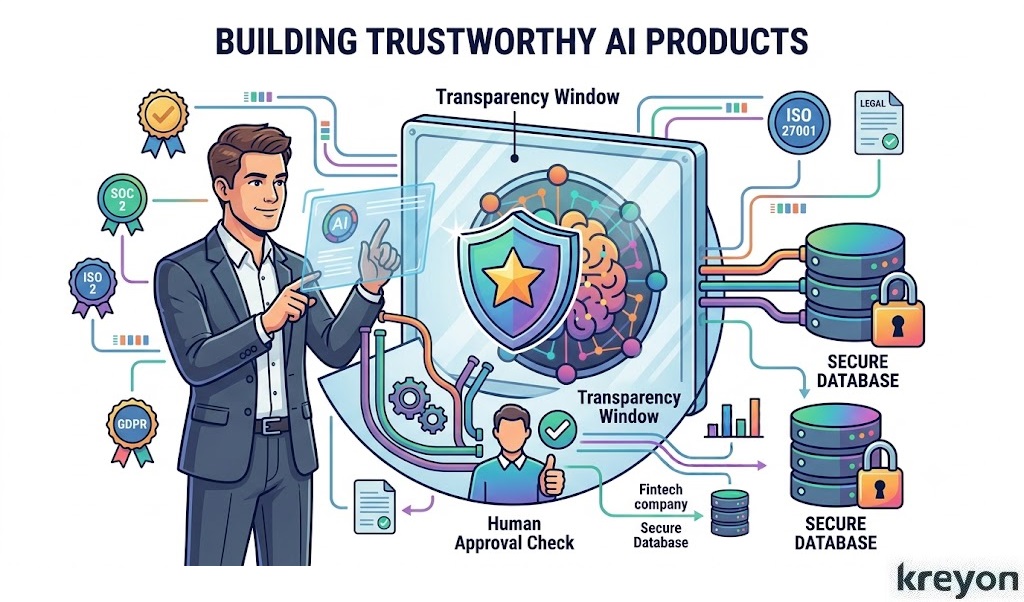
Designing Trust Into the AI Product
Financial workflows require a high level of accuracy.
A mistake in a recommendation could impact:
Compliance
Cash flow
Vendor relationships
Business decisions
Therefore, trust was treated as a product requirement—not a technical feature.
Human-in-the-Loop AI
The goal was not to remove human expertise.
The goal was to enhance it.
For example:
AI recommendation:
“This invoice appears consistent with previous vendor transactions with 94% confidence.”
Human reviewer:
Reviews the recommendation.
Approves the action.
Provides feedback.
This approach created confidence while improving efficiency.
Explainable Recommendations
Instead of providing unexplained outputs, the AI system showed:
Relevant transaction history.
Matching records.
Identified patterns.
Reasons behind recommendations.
Users are more likely to adopt AI when they understand how it works.
Secure Enterprise Integration
The AI platform was designed to work with existing business infrastructure:
Accounting software
ERP systems
Document platforms
Approval workflows
This reduced disruption and accelerated adoption.
Business Outcomes
The transformation delivered value across multiple dimensions.
Faster Operations
Finance teams reduced time spent on repetitive processing activities.
Tasks that previously required hours of manual effort could be completed significantly faster.
Better Financial Visibility
Leadership gained faster access to important insights.
Instead of waiting for reports, decision-makers could interact with financial information in real time.
Improved Accuracy
AI helped identify:
Duplicate transactions
Unusual patterns
Missing information
Potential risks
This reduced operational errors.
Scalable Foundation
The organization created a platform that could expand into additional AI use cases:
Expense management
Vendor intelligence
Cash flow forecasting
Financial reporting automation
The AI investment became a business capability rather than a single project.
The AI Product Management Framework for Enterprise Success
Organizations looking to build successful AI products can follow a structured approach.
Step 1: Discover High-Value AI Opportunities
The best AI opportunities usually exist where businesses experience:
High manual effort
Repetitive decisions
Large volumes of information
Slow processes
Expensive mistakes
The question is not:
“Where can we add AI?”
The better question is:
“Where can intelligence create the greatest business advantage?”
Step 2: Validate the Problem Before Building
Successful AI products start with customer and employee understanding.
Before development begins, teams should evaluate:
Current workflows.
User frustrations.
Business impact.
Adoption barriers.
Success measurements.
This prevents organizations from building solutions nobody needs.
Step 3: Build the Minimum Valuable AI Product
Traditional software often focuses on minimum viable products.
AI products require a slightly different mindset.
The goal is not simply the smallest product.
The goal is the smallest product that creates measurable intelligence.
For example:
Instead of building a complete AI finance platform immediately:
Start with:
Automated invoice classification.
Reconciliation assistance.
Financial insights generation.
Learn from users. Then expand.
Step 4: Create Feedback Loops
AI products improve through learning.
Organizations should collect:
User feedback.
Accuracy observations.
Workflow improvements.
Business outcomes.
This creates a continuous improvement cycle.
Step 5: Scale Responsibly
Enterprise AI requires:
Security controls.
Governance.
Monitoring.
Compliance.
Infrastructure planning.
Scaling AI is not just about handling more users.
It is about maintaining trust as adoption grows.
How Kreyon Systems Helps Businesses Build AI Products That Scale
At Kreyon Systems, we help organizations move beyond AI experimentation and build reliable AI-powered business solutions.
Our approach combines:
AI Product Strategy
Identifying the right opportunities where AI can create measurable business impact.
AI Product Engineering
Building secure, scalable AI applications designed for enterprise needs.
Workflow Automation
Transforming repetitive business processes into intelligent workflows.
Software Integration
Connecting AI capabilities with existing enterprise systems.
AI-Powered Finance Automation
Helping organizations improve:
Accounting operations
Financial workflows
Reporting processes
Document automation
Decision support
Frequently Asked Questions
What is AI Product Management?
AI Product Management is the practice of designing, developing, and scaling AI-powered products by combining product strategy, customer needs, data, AI technology, and business objectives.
Why is AI Product Management important?
AI Product Management helps organizations move beyond AI experiments and build trusted solutions that deliver measurable business outcomes.
How is AI Product Management different from traditional product management?
AI Product Management includes additional considerations such as data quality, model performance, AI governance, explainability, and continuous learning.
How can companies successfully build AI products?
Companies succeed by starting with business problems, designing for user trust, integrating AI into workflows, measuring outcomes, and continuously improving the product.
Final Thoughts: The Future Will Belong to Companies That Build Trusted AI Products
Artificial intelligence is not valuable because it is innovative.
It is valuable because it changes what businesses can achieve.
The organizations that succeed will not be those that simply adopt AI tools.
They will be those that build AI products people trust, employees embrace, and businesses can scale.
That requires a disciplined approach to AI Product Management.
It requires understanding customers.
It requires designing for trust.
It requires connecting technology with measurable outcomes.
Most importantly, it requires moving from AI experimentation to AI execution.
The next generation of market leaders will not ask:
“How can we use AI?”
They will ask:
“How can we build intelligent products that create lasting business advantage?”
Kreyon Systems partners with organizations to design, build, and scale AI-powered products that solve real business challenges and deliver measurable outcomes. For queries, please reach out to us.
The post AI Product Management: Building Trusted AI Products That Scale and Deliver Business Outcomes appeared first on Kreyon Systems | Blog | Software Company | Software Development | Software Design.