
How to Slash Bookkeeping Costs by 50% with AI bookkeeping automation: A Practical Guide for CFOs
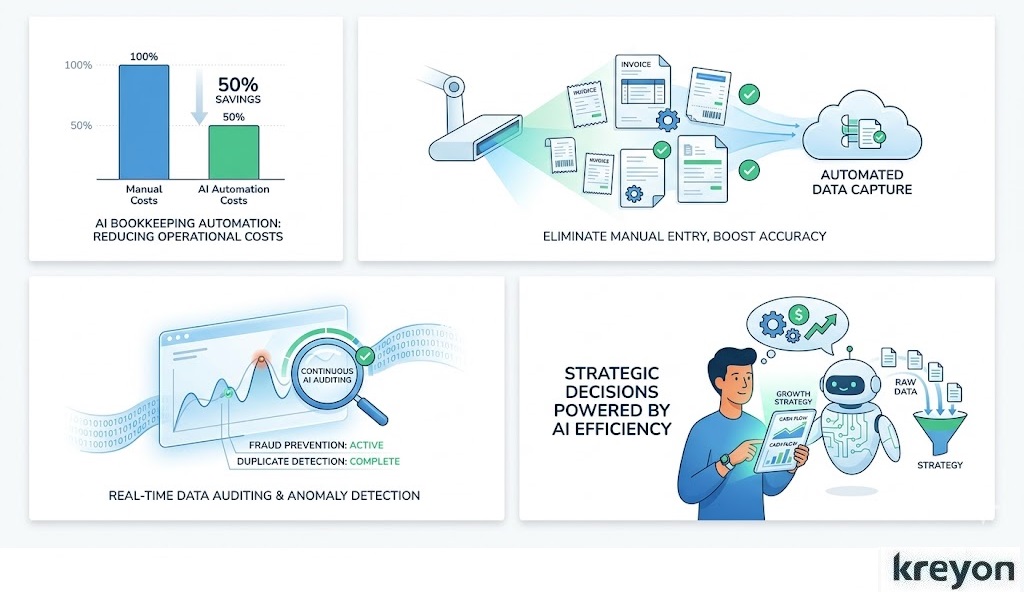
For decades, the back office was the enterprise “black box,” a necessary cost center where manual data entry lived on and efficiency often went to die.
Finance leaders simply accepted the “Accounting Tax”: the frustrating reality that as a business grows, the cost of tracking that growth scales linearly with headcount.
We are now entering the AI era. AI bookkeeping automation isn’t just about replacing a spreadsheet; it’s about a fundamental shift in the unit economics of financial oversight.
By moving from reactive, human-led entry to proactive, machine-led verification, firms are seeing radical reductions in overhead.
If you are aiming to cut bookkeeping costs by 50% with AI automation, you aren’t just buying software. You are redesigning the heartbeat of your business for speed, accuracy, and strategic insight.
1. The Hidden Drain: Why Accounting is Your Biggest Opportunity
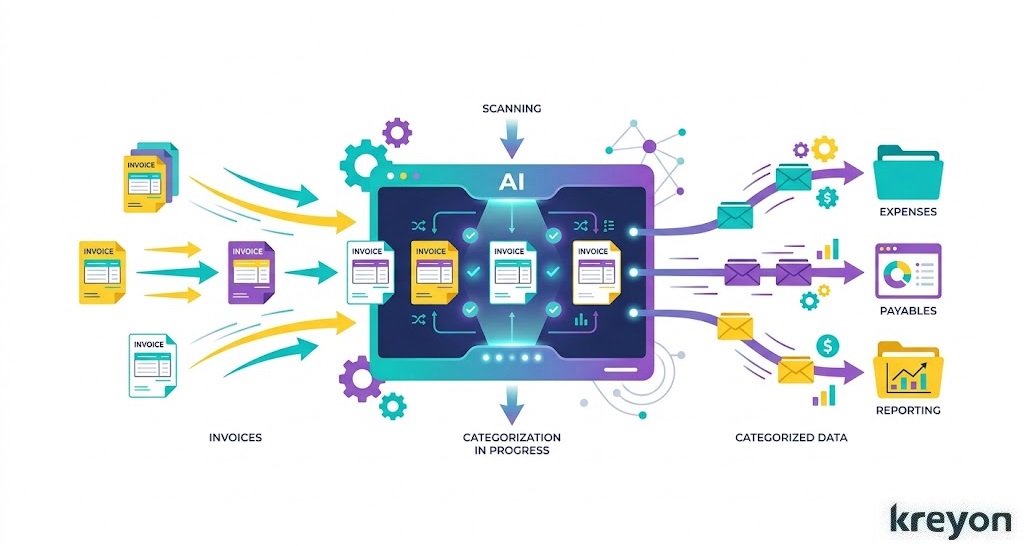
Most organizations drastically underestimate their true Cost Per Transaction. When you factor in a bookkeeper’s hourly rate, software licenses, the inevitable 3–5% manual error rate, and the “rework time” spent fixing those mistakes, the price tag is staggering.
Traditional bookkeeping is “chunky.” Data arrives in batches, is processed in batches, and produces reports weeks after the fact. This lag creates a “visibility gap” that costs businesses thousands in missed opportunities and poor cash flow management.
The AI Advantage: AI shifts the paradigm to real-time processing. When machines handle the ingestion of receipts, invoices, and bank feeds, the marginal cost of an additional transaction drops toward zero. Recent industry data shows that businesses utilizing AI bookkeeping automation are achieving:
-
30–60% reduction in overall accounting overhead.
-
70% time savings on routine tasks.
-
Month-end closes dropping from 12 days to just 3 or 4.
2. Eliminating the “Data Entry Trap” with Intelligent Capture
The primary lever for a 50% cost cut is the total removal of rote data entry. Modern AI combines Optical Character Recognition (OCR) with Machine Learning (ML) to do more than just “read” a document, it understands the intent behind it.
A. Contextual Categorization
A basic, rule-based system might see “Amazon” and guess “Office Supplies.” An AI-driven system is smarter. It analyzes:
-
Historical ledger patterns.
-
The department of the purchaser.
-
Specific SKU data and vendor behavior.
It then accurately classifies the expense as “Cloud Infrastructure,” “Marketing Assets,” or “Research Materials” with 95% accuracy.
B. The 24/7 Digital Auditor
Algorithms don’t get tired at 4:00 PM on a Friday. AI bookkeeping automation acts as a continuous auditor, flagging anomalies, duplicate invoices, or suspicious patterns the second they occur. This prevents “leakage” before it hits your bank account.
Tools report reconciliation time reductions of ~50%, with some achieving 80–92% faster cycles.
3. Strategic Reallocation: Turning Number Crunchers into Growth Architects
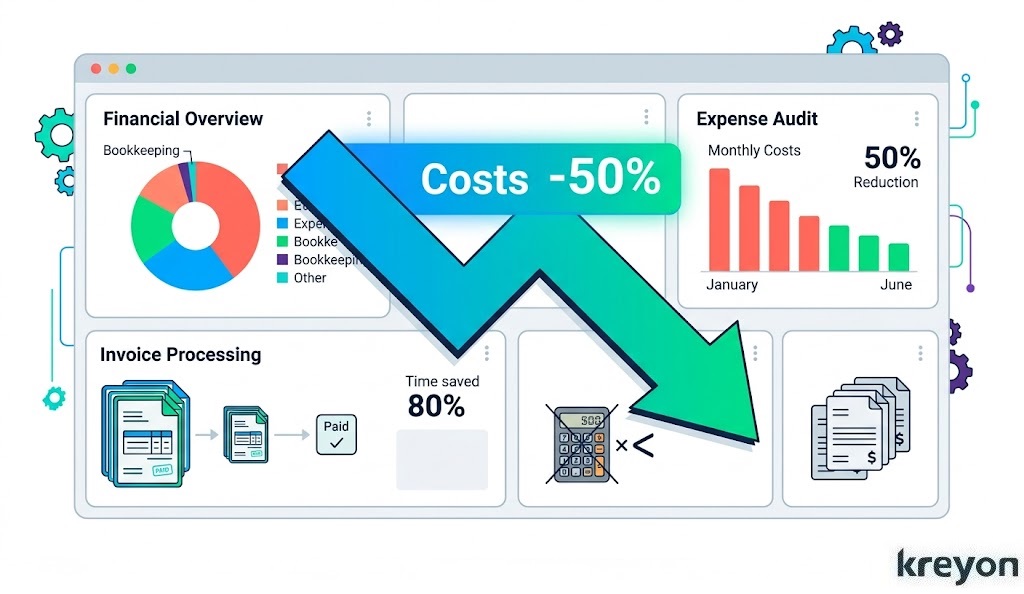
When AI handles the “What” (the transactions), your finance team is finally free to focus on the “So What?” (the strategy).
Imagine a world where your accounting department doesn’t just tell you where the money went, but where it should go next. By automating the mundane, you can reallocate your budget toward high-value activities:
-
Dynamic Cash Flow Forecasting: Predicting liquidity 6 months out.
-
Variance Analysis: Understanding exactly why certain departments are over budget in real-time.
-
Advisory Insights: Using financial data to drive M&A or product expansion decisions.
“The goal of AI in finance isn’t to replace the accountant, but to augment their intuition with unfailing accuracy.” Global Finance Leadership Review
4. The Implementation Blueprint: How to Hit the 50% Mark
Achieving a true 50% reduction requires more than a software subscription; it requires a thoughtful rollout. Here is how the most successful firms do it:
-
Standardize the Inputs: Move all vendors to digital invoicing. The cleaner the data coming in, the faster the AI can process it.
-
Human-in-the-Loop (HITL): Use a system that auto-processes high-confidence items and only escalates “edge cases” to your team. This allows the AI to learn your business nuances over time.
-
Integrate the Tech Stack: Siloed data is the enemy of automation. Your AI must speak directly to your ERP and banking APIs to ensure a “Single Source of Truth.”
-
Start Small, Scale Fast: Pilot AI in high-volume areas like Accounts Payable (AP) or expense management. Most firms see a full ROI within 3 to 9 months.
5. Why Custom Solutions Outperform Off-the-Shelf Software

While generic apps exist, enterprises with complex workflows often find them limiting. This is where Kreyon Systems steps in. We specialize in building bespoke AI-driven finance automation tailored to your unique infrastructure.
From intelligent bookkeeping modules and asset management to full ERP integrations, we ensure your automation isn’t just a “bolt-on” tool, but a core competitive advantage.
We focus on “data readiness,” ensuring your existing messy data is cleaned and primed for AI success.
Kreyon Systems specializes in building or customizing exactly these AI-driven finance automation solutions.
It includes data preparation for AI, intelligent bookkeeping modules & full ERP integrations, tailored for businesses that want scalable, cost-effective results without off-the-shelf limitations.
The Bottom Line: Efficiency as a Competitive Advantage
In a volatile market, real-time financial visibility is a superpower. AI bookkeeping automation is no longer a luxury for Silicon Valley startups—it is the new global standard for any business that prioritizes precision and scalability.
The math is clear. The technology is here. The only question is: How quickly can you move before your competitors leave you behind in the spreadsheets of the past?
Summary & Next Steps
Cutting costs by 50% is a calculated shift, not a gamble. By focusing on data integrity, real-time auditing, and reallocating your talent to strategic work, you turn your finance function into a lean, insight-driven engine.
At Kreyon Systems, we design and implement custom AI bookkeeping automation solutions tailored to your workflows. Ready to see what your Automation ROI looks like? Please contact us for queries.