
AI Agents for Business Automation: The Next Competitive Advantage for Modern Enterprises
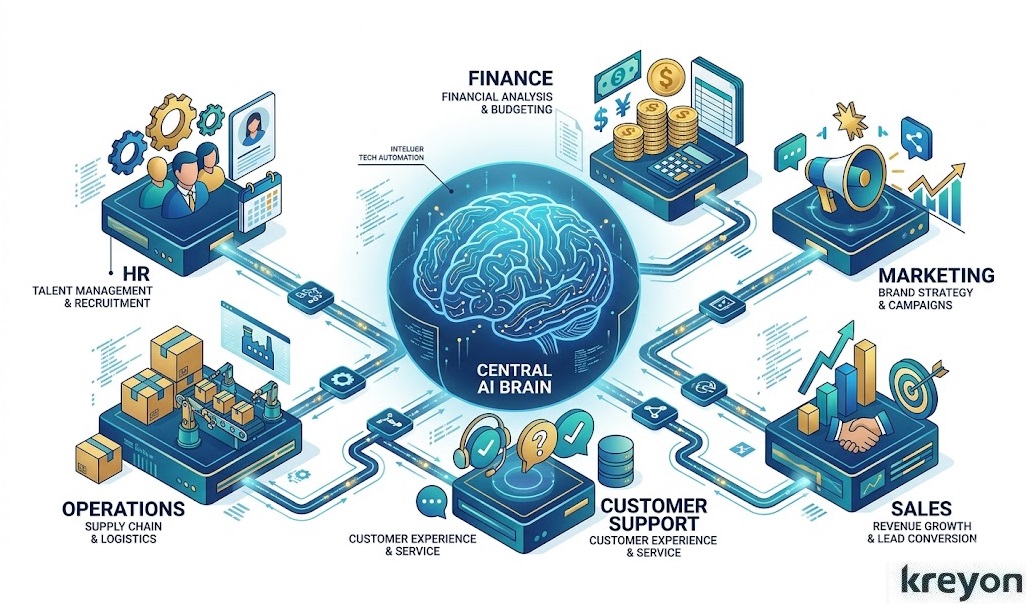
The quiet revolution happening inside modern businesses starts with AI and automation. Every major business transformation begins with a simple question:
What if we could do more with less effort?
For decades, organizations have pursued efficiency through software, outsourcing, and process optimization.
Yet despite significant investments, many teams still spend countless hours on repetitive tasks, responding to customer inquiries, processing invoices, scheduling meetings, analyzing reports, & coordinating workflows across departments.
Today, a new wave of technology is changing that equation.
AI Agents for Business Automation are rapidly emerging as one of the most significant innovations in enterprise technology. Unlike traditional automation tools that follow rigid rules, AI agents can understand context, make decisions, learn from interactions, and execute tasks with minimal human intervention.
This isn’t simply another software upgrade. It’s a fundamental shift in how work gets done.
Organizations that successfully integrate AI agents are discovering something remarkable: automation is no longer just about reducing costs. It’s becoming a strategic tool for increasing innovation, improving customer experiences, and creating entirely new business capabilities.
The question is no longer whether AI agents will transform business operations. The question is how quickly organizations can adapt.
Understanding AI Agents for Business Automation
To appreciate their impact, it’s important to understand what makes AI agents different from traditional automation systems.
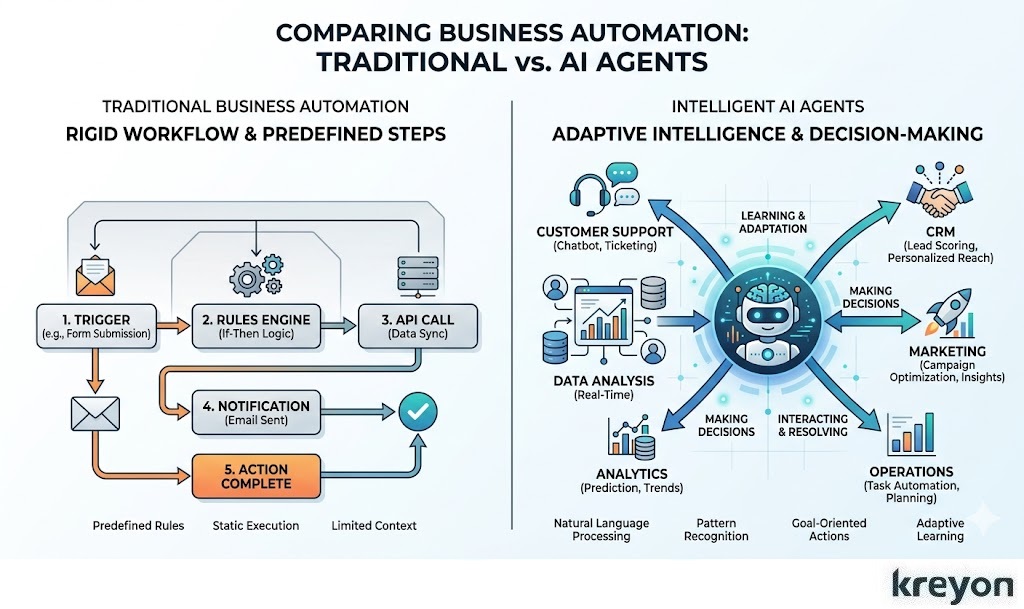
Traditional automation follows predefined instructions.
If X happens, perform Y.
AI agents operate differently. They combine advanced language models, reasoning capabilities, memory systems, and workflow integrations to accomplish goals rather than simply execute commands.
Imagine a customer service request arrives at your company.
A conventional automation platform might route the ticket to the correct department.
An AI agent can:
- Read and understand the request
- Access customer history
- Analyze sentiment
- Draft a personalized response
- Escalate when necessary
- Follow up automatically
- Update CRM records
All within seconds.
The result is not merely task automation. It is intelligent process execution.
Businesses increasingly view AI agents as digital teammates rather than software tools because they can actively participate in workflows instead of simply supporting them.
[Traditional RPA] ───> Requires Fixed Inputs ───> Breaks on Deviations
[AI Agent Architecture] ───> Evaluates Context ───> Adapts & Solves Dynamically
Deploying AI Agents for Business Automation fundamentally rewires this dynamic. Because these systems are built on top of advanced large language models, they don’t just follow a static recipe, they understand the underlying goal.
If an agent encounters an unfamiliar invoice format, it doesn’t throw its hands up and crash. It reads the page contextually, locates the total cost, cross-references it with the purchase order in your ERP system, notes the discrepancy, and drafts a polite, context-aware email to the supplier asking for clarification.
You no longer tell the computer how to do the job; you simply tell it what goal needs to be accomplished.
Why AI Agents for Business Automation Are Gaining Momentum
Several factors have accelerated adoption.
First, businesses face mounting pressure to improve productivity without significantly increasing headcount.
Second, customers expect faster responses and more personalized experiences.
Third, advances in generative AI have dramatically improved machine reasoning and communication capabilities.
According to research from the World Economic Forum, AI-driven technologies are expected to reshape millions of jobs globally while creating new opportunities for higher-value work.
Similarly, studies from McKinsey & Company suggest that generative AI could contribute trillions of dollars in economic value annually through productivity gains.
These developments are encouraging executives to rethink how work is structured across their organizations.
Anatomy of an Enterprise AI Agent
What actually happens under the hood of an enterprise-grade AI agent? While chatbots rely entirely on a simple input-output loop, an autonomous agent utilizes a dynamic multi-layered cognitive architecture:
-
The Core Engine (LLM): This acts as the central nervous system, providing the foundational reasoning capabilities, linguistic understanding, and contextual awareness.
-
Memory Systems:
-
Short-term memory: Retains the immediate context of the current task or conversation.
-
Long-term memory: Utilizes vector databases to recall past interactions, corporate policies, and historical data patterns over long horizons.
-
-
Planning and Reflection: The capacity to break a massive, ambiguous goal down into sequential sub-tasks. Crucially, advanced agents possess a “self-reflection” loop, allowing them to evaluate their own work, identify errors in their logic, and course-correct before executing an action.
-
Tool Integration (Tool Use): The ability to interact with external environments. Agents are given access to APIs, databases, Slack channels, CRM software, and web browsers, allowing them to actively pull and push data across your existing tech stack.
How AI Agents for Business Automation Transform Operations
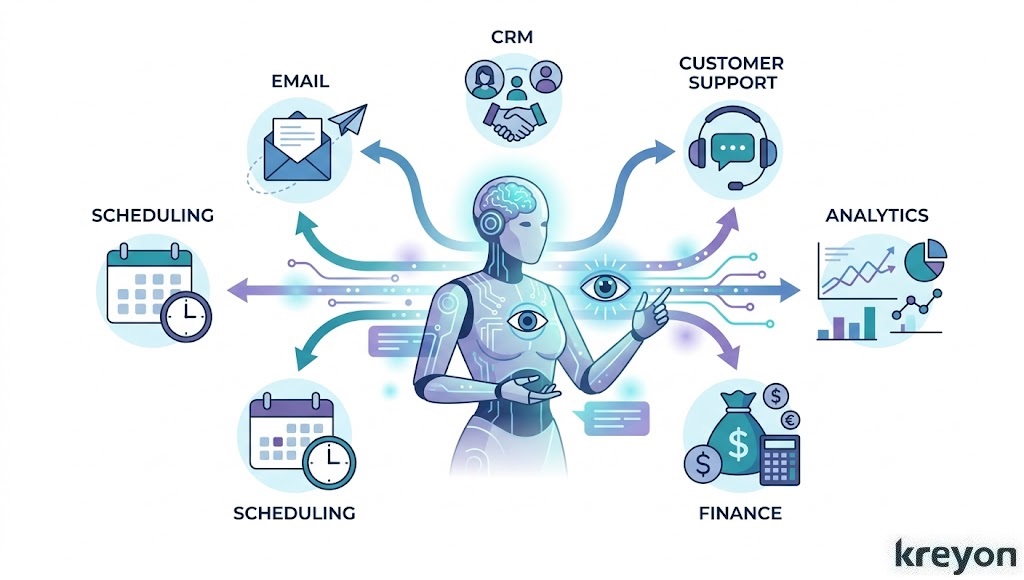
The true value of AI agents becomes clear when examining their practical applications.
Customer Service Automation
Customer support teams often face overwhelming ticket volumes.
AI agents can handle routine inquiries, troubleshoot common issues, process returns, and provide personalized recommendations.
For example, an e-commerce retailer might deploy AI agents to answer order-status questions instantly, reducing wait times while allowing human representatives to focus on complex situations.
Customers receive faster support.
Employees experience less burnout.
Businesses reduce operational costs.
Everyone benefits.
Sales and Lead Management
Sales professionals spend considerable time on administrative activities.
AI agents can:
- Qualify leads
- Schedule meetings
- Draft outreach emails
- Update CRM systems
- Conduct follow-ups
Rather than replacing sales teams, AI agents amplify their effectiveness by eliminating repetitive work.
The result is more time spent building relationships and closing deals.
Finance and Accounting
Financial departments often manage high volumes of repetitive transactions.
AI agents can automate:
- Invoice processing
- Expense categorization
- Reconciliation workflows
- Compliance reporting
- Financial forecasting support
This not only increases efficiency but also reduces the likelihood of costly human errors.
Human Resources
Recruitment and employee management involve countless administrative processes.
AI agents can screen resumes, coordinate interviews, answer employee questions, onboard new hires, and monitor workforce trends.
HR professionals gain more time to focus on culture, leadership development, and strategic workforce planning.
The Strategic Benefits of AI Agents for Business Automation
Many organizations initially pursue automation to reduce costs.
However, the greatest benefits often emerge elsewhere.
Enhanced Productivity
Employees spend less time on repetitive tasks and more time on high-value activities.
When routine work is delegated to AI agents, teams can focus on creativity, strategy, and innovation.
Faster Decision-Making
AI agents can gather data from multiple systems, summarize findings, and present actionable recommendations.
Instead of waiting days for reports, leaders receive insights in minutes.
Improved Scalability
Businesses can expand operations without proportionally increasing staffing requirements.
This flexibility is particularly valuable during periods of rapid growth.
Better Customer Experiences
Modern consumers expect speed, personalization, and consistency.
AI agents help organizations meet those expectations around the clock.
Challenges of Implementing AI Agents for Business Automation
Despite the excitement, implementation is not without challenges.
Organizations that underestimate these complexities often struggle to achieve meaningful results.
Data Quality Issues
AI agents are only as effective as the information they access.
Incomplete, inaccurate, or fragmented data can significantly reduce performance.
Businesses must establish strong data governance practices before scaling AI initiatives.
Security and Compliance Concerns
AI agents frequently interact with sensitive information.
Organizations must ensure compliance with privacy regulations and implement robust cybersecurity measures.
Trust is difficult to earn and easy to lose.
Change Management
Technology adoption is rarely a technical challenge alone.
Employees may fear displacement or uncertainty.
Successful organizations invest heavily in communication, training, and workforce development.
The most effective leaders position AI as an augmentation tool rather than a replacement strategy.
Building a Successful AI Agents for Business Automation Strategy
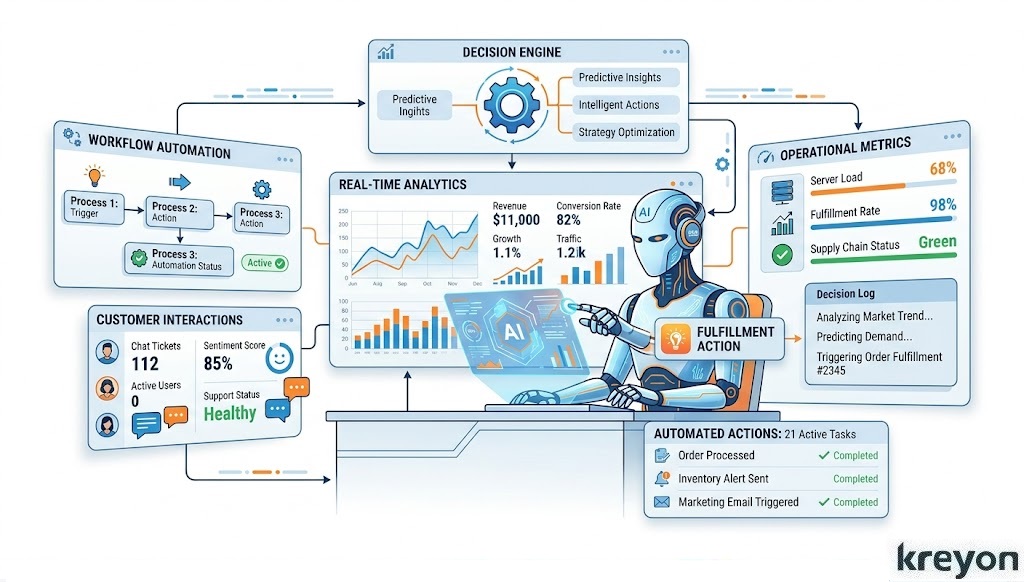
The organizations generating the greatest returns from AI are not necessarily the most technologically advanced.
They are the most disciplined.
Start with High-Impact Use Cases
Rather than attempting enterprise-wide transformation immediately, identify areas where automation can deliver measurable value quickly.
Examples include:
- Customer support
- Sales operations
- Invoice processing
- Employee self-service
Early wins create momentum.
Establish Clear Governance
Define ownership, accountability, security protocols, and performance metrics.
AI initiatives require ongoing oversight to ensure reliability and compliance.
Measure Business Outcomes
Focus on business results rather than technical achievements.
Track metrics such as:
- Cost savings
- Productivity improvements
- Customer satisfaction
- Revenue growth
- Employee engagement
Technology is only valuable when it contributes to organizational objectives.
Next Generation AI Agents for Business Automation
The next generation of AI agents will be significantly more capable than today’s systems.
Emerging developments include:
- Multi-agent collaboration
- Autonomous workflow orchestration
- Real-time decision optimization
- Advanced predictive analytics
- Industry-specific AI ecosystems
Imagine an entire workflow where multiple AI agents coordinate independently.
One agent identifies a customer opportunity.
Another prepares a proposal.
A third handles contract generation.
A fourth schedules implementation.
Human oversight remains essential, but the majority of operational work occurs autonomously.
This future is arriving faster than many executives anticipate.
Organizations that begin building AI capabilities today will be better positioned to compete tomorrow.
Turning AI Potential into Business Value
The conversation surrounding artificial intelligence often focuses on technology.
Yet the real story is business transformation.
AI Agents for Business Automation are redefining how organizations operate, compete, and grow. They reduce repetitive work, improve decision-making, enhance customer experiences, and unlock entirely new levels of productivity.
The companies that thrive in the coming decade will not necessarily be those with the largest budgets or the most employees.
They will be the organizations that learn how to combine human creativity with intelligent automation.
AI agents are not simply another tool in the technology stack. They represent a new operating model for modern business.
The opportunity is substantial. The competitive advantages are real. And the time to begin exploring them is now.
Kreyon Systems builds autonomous AI Agents that don’t just answer questions, they orchestrate, adapt, & execute complex workflows from end to end. For queries, please contact us.