
What is AI Bookkeeping and How Does It Work?
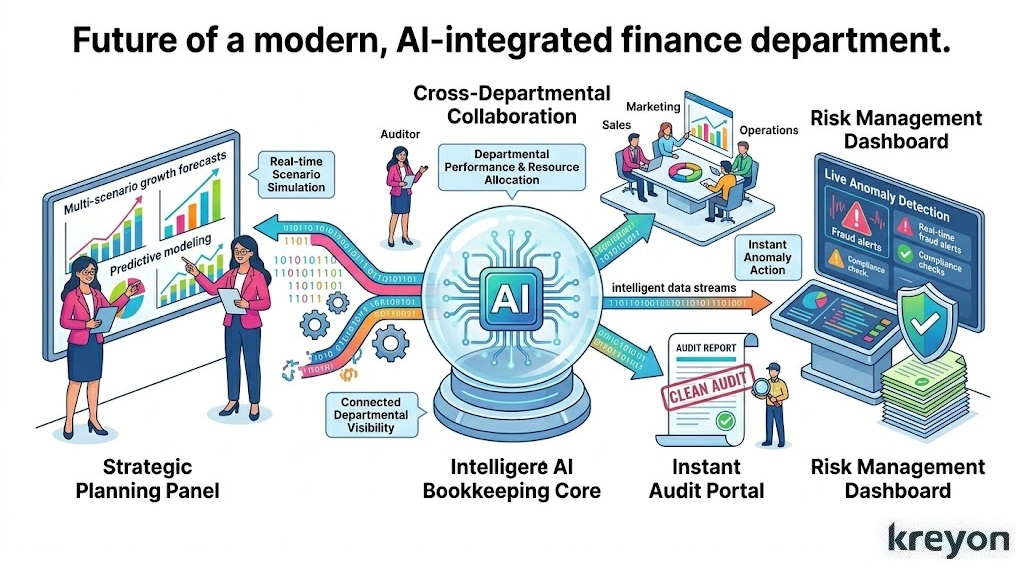
For decades, the rhythm of corporate finance has been dictated by the ledger. Every month, an invisible mountain of invoices, receipts, and bank statements lands on the desks of finance teams.
What follows is a familiar, grueling ritual: manual data entry, tedious line-item matching, and the frantic hunt for a missing receipt that is throwing off the entire reconciliation. It is a process that is slow, expensive, and frustratingly prone to human slip-ups.
But a quiet paradigm shift is happening. Forward-thinking enterprises are moving away from legacy, reactive accounting. Instead, they are adopting automated, continuous financial infrastructure powered by AI bookkeeping.
So, what exactly is AI bookkeeping, and how does it function inside a modern enterprise? More importantly, how can leaders move past the vendor hype to build an autonomous finance function that actually delivers strategic value?
Understanding AI Bookkeeping: Moving Beyond the Ledger
At its core, AI bookkeeping is the application of artificial intelligence, machine learning, and advanced pattern recognition to completely automate the collection, categorization, and reconciliation of financial data.
[Raw Financial Data] ──> [AI Processing Layer] ──> [Autonomous Ledger]
  • Invoices & Receipts     • OCR & Vision Models     • Perfect Categorization
  • Bank & Card Feeds       • Pattern Recognition     • Continuous Match
  • ERP Systems             • Anomaly Detection       • Audit-Ready State
To understand what it is, it helps to understand what it is not. It is not just a digital spreadsheet or a basic set of “if-then” software rules.
Traditional automated accounting software requires a human to manually build and maintain rigid rules for every single vendor or transaction type. If a vendor changes their invoice layout even slightly, the rule breaks.
True AI bookkeeping systems learn from your historical accounting data. They don’t just execute rules; they understand context.
If an executive charges a $150 dinner to a corporate card, the AI analyzes the merchant data, references the company’s historical chart of accounts, checks the employee’s department, and accurately logs it as client entertainment, all without a human ever touching a keyboard.
According to a study published by Mordor Intelligence, the global AI in accounting market is surging at an annual growth rate of over 44%. This isn’t just because companies want to replace old software; it’s because they need to fundamentally change how fast financial data moves through the business.
How Does AI Bookkeeping Work? The Technical Mechanics
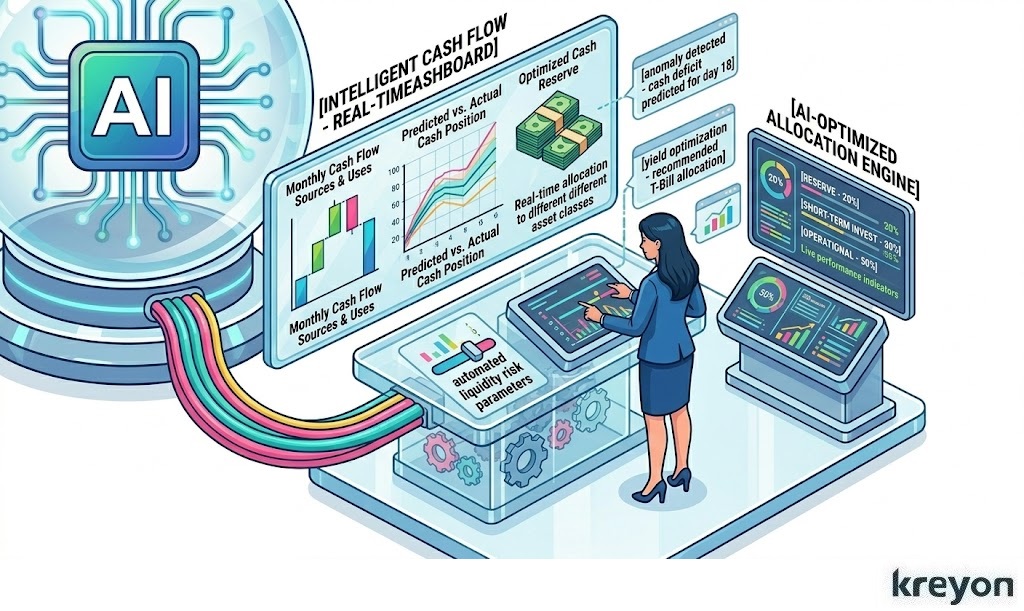
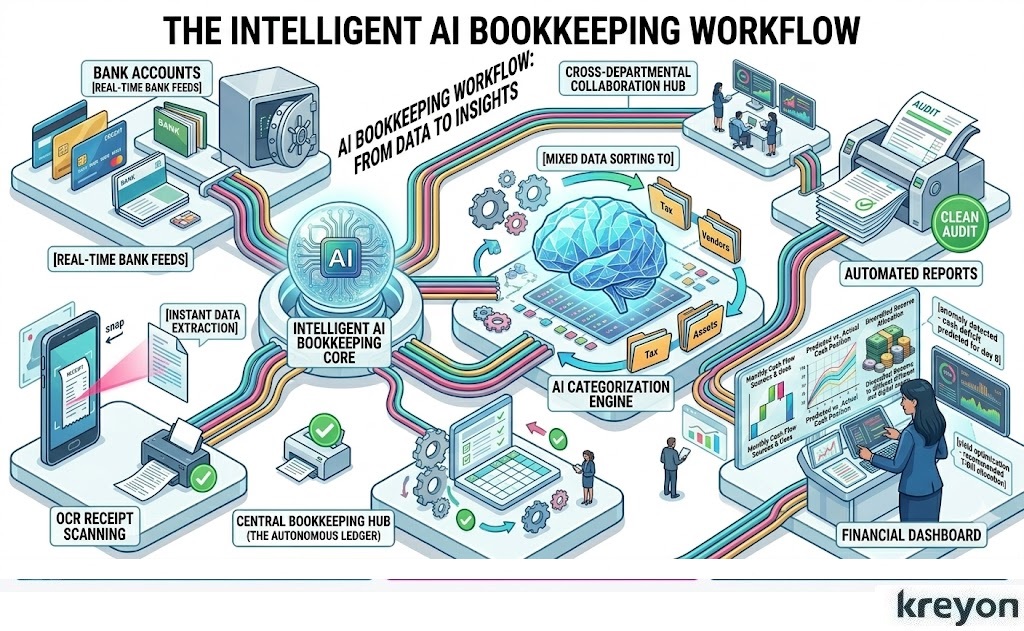
The magic of an autonomous ledger happens behind the scenes through a sophisticated, multi-step pipeline. When a business connects an AI bookkeeping platform to its core infrastructure, the software executes four critical phases in real time:
1. Multi-Channel Data Ingestion
The process begins with document and data ingestion. Instead of waiting for a bookkeeper to scan receipts at the end of the month, the AI sits directly on top of your financial plumbing. It hooks into your bank feeds, credit card portals, and your corporate ERP system.
For unstructured data, like a PDF invoice sitting in an AP inbox or a snapped photo of a lunch receipt—the system uses deep-learning-based Optical Character Recognition (OCR) and computer vision to extract line items, sales tax, dates, and vendor names with incredible accuracy.
2. Contextual Expense Categorization
Once the data is inside the system, machine learning algorithms take over. Rather than relying on simple keyword matching, the AI evaluates the transaction context. It looks at historical behavior, industry standards, and the specific chart of accounts used by your firm.
After collecting transaction data, AI models begin classifying expenses and revenue into appropriate accounting categories. For example:
A payment to a software vendor may automatically be categorized as “Software Expense”
A recurring payment to a logistics company may be labeled under “Shipping Costs”
A purchase of a laptop could be marked as a “Computer Equipment under Fixed Assets”
The system improves over time by learning from historical bookkeeping patterns and user corrections.
This is where machine learning becomes particularly valuable. Unlike static automation rules, AI systems adapt and become more accurate as they process larger datasets.
3. Continuous Bank Reconciliation
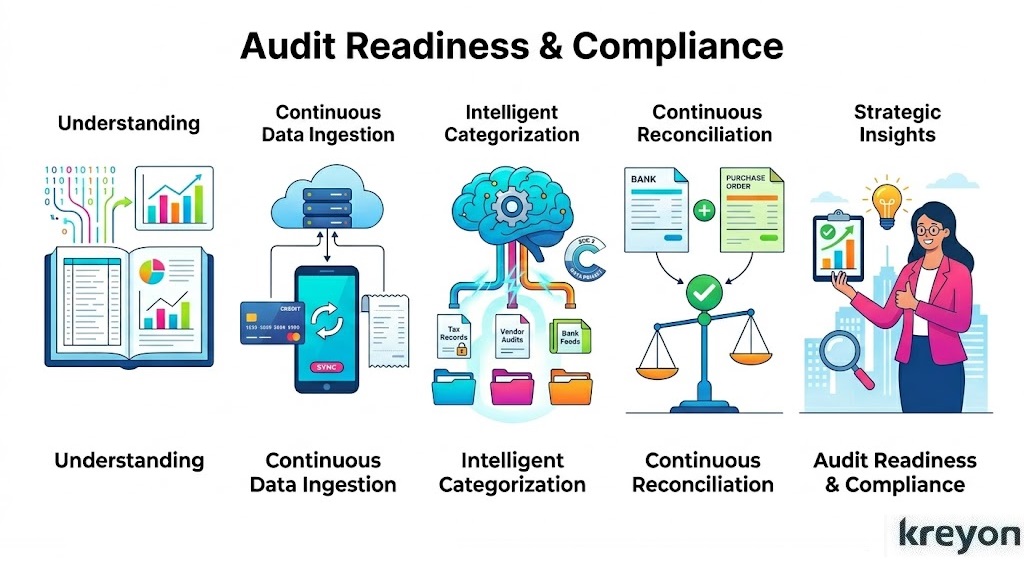
In a traditional setup, bank reconciliation is a monthly bottleneck. Bookkeepers match bank statements against internal ledgers weeks after the actual transactions occurred. AI turns this into a real-time, continuous process.
The system matches bank transactions with corresponding invoices and purchase orders as they happen. If a match is certain, it reconciles it automatically. If it detects a discrepancy, like an annual insurance premium booked entirely in a single month rather than being amortized over the year, it flags it instantly.
In practical terms, AI bookkeeping software can:
Categorize transactions automatically
Reconcile bank statements
Process invoices and receipts
Detect anomalies or duplicate expenses
Generate financial reports in real time
Predict cash flow patterns
4. Real-Time Anomaly and Fraud Detection
Because the AI monitors the flow of capital continuously, it serves as an automated internal auditor. It can comb through tens of thousands of transactions to instantly flag duplicate payments, unusual spending spikes, or atypical vendor behavior.
This shifts risk management from an after-the-fact cleanup to an active, preventative line of defense.
Traditional bookkeeping is vulnerable to mistakes:
duplicate entries
missed invoices
incorrect expense categories
reconciliation errors
Even small financial inaccuracies can create compliance risks or poor business decisions.
AI bookkeeping systems reduce these risks by standardizing processes and flagging anomalies automatically.
The Strategic Dividends of an Autonomous Finance Team
The business case for deploying AI bookkeeping goes far beyond saving hours on data entry. The real value is how it transforms the role of finance within the organization.
-
Drastic Error Reduction: Data compiled by McKinsey & Company indicates that companies leveraging financial automation reduce transaction processing errors by up to 75%. Eliminating manual keying errors means cleaner books and significantly less time spent fixing mistakes during audit season.
-
The “Continuous Close”: Waiting 15 days after month-end to close the books is an archaic practice that kills agility. With continuous AI reconciliation, leaders gain access to real-time financial reporting. You can look at an accurate profit-and-loss statement on the 12th of the month, not just the 30th.
-
From Data Processors to Strategic Advisors: When intelligent software handles clerical workflows, accounting professionals are freed from the keyboard. They can pivot into higher-value advisory roles—analyzing unit economics, optimizing working capital, or building predictive cash flow models.
Navigating the Implementation Challenges
While the benefits are clear, transitioning to an AI-driven bookkeeping model isn’t without its speed bumps. Leaders must approach adoption with a clear strategy for two major headwinds:
Data Privacy and Security
Financial data is highly sensitive. Passing corporate ledgers through third-party AI models requires strict compliance with modern data privacy frameworks.
Enterprise leaders must ensure that any AI vendor they partner with uses bank-grade encryption, holds SOC 2 Type II certifications, and ensures that company data is never used to train public, open-source models.
The Accounting Skills Gap
The biggest hurdle isn’t actually the technology; it’s the talent. There is a growing skills gap in the financial sector. Traditional accounting education focuses heavily on compliance, rules, and manual auditing, but modern finance departments need professionals who understand data architecture and algorithmic oversight.
Organizations must invest in upskilling their teams, training them to transition from creators of financial data to editors and analysts of AI-generated insights.
The Path Forward
AI bookkeeping is no longer a futuristic concept or an experimental line item for tech startups. It has matured into a foundational operational tool that drives efficiency, accuracy, and real-time business visibility.
The choice facing modern executives is no longer about whether to adopt automation, but how quickly they can execute the transition.
By offloading the mechanical, repetitive burdens of accounting to intelligent systems, companies don’t just clean up their books, they unlock the full strategic potential of their finance teams.
Eventually, finance teams may spend less time “recording the past” and more time shaping future business strategy.
Automate your bookkeeping with AI-powered accuracy and real-time financial insights. Transform accounting into intelligent finance operations with Kreyon Systems. For queries, please contact us.