
The Hidden Cost of Disconnected Software: Why SMBs Need Integration Before AI
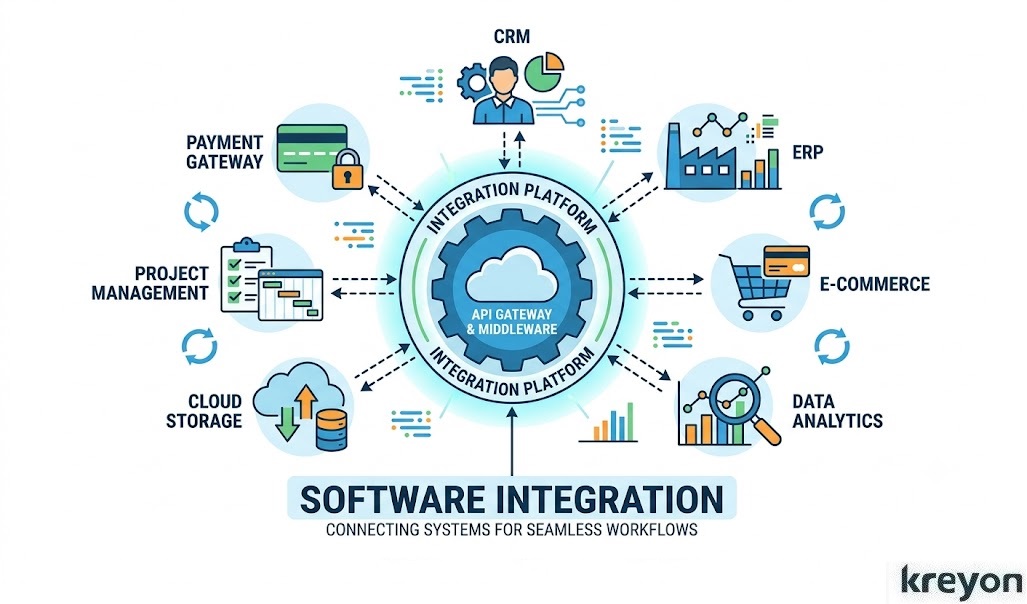
Most business owners don’t wake up thinking about disconnected software. They wake up thinking about sales, payroll, customers, and whether their team is overwhelmed again this week.
But here’s the uncomfortable truth: disconnected software is often the invisible reason behind all that chaos.
If your CRM, accounting system, marketing tools, and operations platforms don’t talk to each other, you’re not running one business system, you’re running five or six mini systems that constantly fight each other for attention.
And the cost of that friction adds up fast: wasted hours, duplicated work, missed leads, and decisions based on incomplete data. Now here’s where it gets interesting.
Everyone is rushing toward AI. But most SMBs are trying to layer AI on top of broken systems.
That’s like installing a turbo engine on a car with misaligned wheels.
Before AI can actually help your business, you need to fix the foundation: integration.
What “Disconnected Software” Really Means for SMBs
At first glance, most SMBs feel “digitally mature” because they already use modern tools:
- A CRM like HubSpot or Salesforce
- Accounting tools like QuickBooks
- Marketing automation platforms
- Spreadsheets everywhere in between
But if you look closer, you’ll usually find something else:
- Sales data lives in one system
- Finance data lives in another
- Customer communication lives in email or chat tools
- Operations data is scattered across sheets and apps
This is what we call disconnected software.
And the problem isn’t the tools themselves, it’s the lack of a unified system where data flows automatically between them.
According to McKinsey’s research on digital transformation, employees spend nearly 1.8 hours every day just searching for and reconciling information across systems. That’s almost 20% of their workweek lost to fragmentation.
Now multiply that across a 25-person team.
You’re not just losing time. You’re losing momentum.
The Real Cost of Disconnected Software in Daily Operations
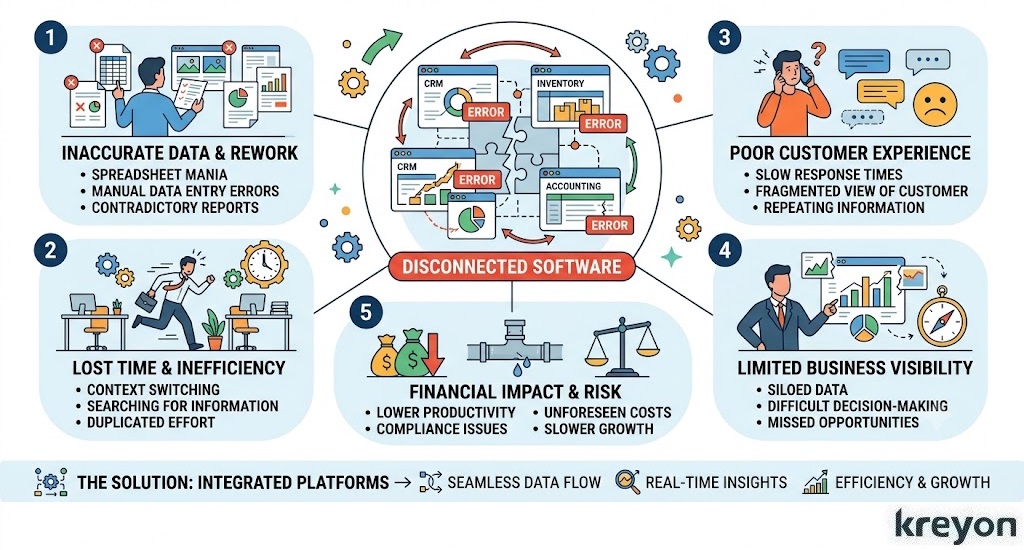
Let’s make this real.
Imagine a typical SMB workflow:
- A lead comes in through a website form
- It enters the CRM
- A sales rep manually copies it into another tool
- Marketing doesn’t know the lead exists
- Finance doesn’t know when it converts
- Reporting is done manually in Excel at the end of the month
Nothing is technically “broken,” but everything is inefficient.
Here’s what that actually costs:
1. Duplicate Work
Employees re-enter the same data across systems. It’s slow, repetitive, and error-prone.
2. Lost Leads
When systems aren’t synced, follow-ups fall through the cracks. Leads go cold without anyone noticing.
3. Delayed Decisions
Leadership gets reports days or weeks late, meaning decisions are based on outdated information.
4. Employee Burnout
People spend their time doing administrative work instead of meaningful work.
A report by Harvard Business Review found that poor data integration is one of the leading causes of operational inefficiency in mid-sized firms.
Why Disconnected Software Breaks AI
Here’s where many SMBs make a critical mistake. They think AI will “fix” inefficiency.
It won’t. AI is not magic, it’s an amplifier.
If your systems are clean and integrated, AI makes them faster and smarter.
If your systems are fragmented, AI makes the chaos faster and more confusing.
Think of AI like a chef. If you give the chef organized ingredients, you get a great meal.
If you give the chef random, unlabeled, half-raw ingredients from different kitchens, you get disaster.
This is why companies with disconnected software struggle with AI adoption.
Common failures include:
- AI tools trained on incomplete data
- Chatbots giving wrong answers because CRM data is outdated
- Automation workflows breaking due to inconsistent inputs
- Poor decision-making because data sources don’t match
Before AI, you need data harmony. And data harmony only comes from integration.
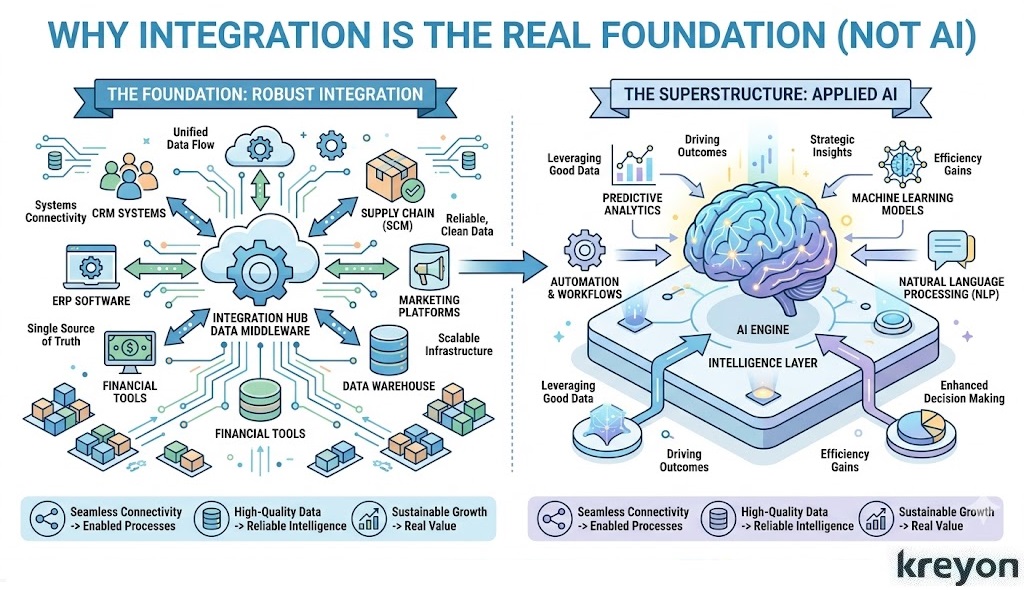
Why Integration Is the Real Foundation (Not AI)
Integration is not glamorous. It doesn’t get headlines. But it’s what separates scalable companies from chaotic ones.
When SMBs fix disconnected software by integrating their systems, something powerful happens:
1. One Source of Truth
Everyone works from the same data instead of conflicting versions.
2. Real-Time Visibility
Leaders can see what’s happening across sales, finance, and operations instantly.
3. Automation Becomes Possible
Once systems talk to each other, workflows can run automatically:
- Lead → CRM → Email sequence → Sales notification
- Invoice → Accounting → Payment reminders
- Customer ticket → Support system → Resolution tracking
4. AI Actually Works
Clean, structured, connected data makes AI accurate and useful.
Without integration, AI is guessing. With integration, AI is executing.
The Strategic Blueprint: Unified Architecture as Your True Competitive Edge
Achieving a unified architecture does not necessarily mean ripping out every tool you love and replacing them with a massive, rigid enterprise platform. Modern cloud infrastructure offers highly elegant integration options:
-
Robust Native Integrations: Prioritize SaaS tools that offer deep, built-in APIs designed to share data seamlessly in real-time.
-
Modern Integration Platforms (iPaaS): Utilize middleware services to build automated workflows between specialized applications without requiring custom code.
-
Design Thinking for Operations: Map out your customer and data journeys from end to end before writing code or buying software. Ensure your workflows mirror how humans actually want to work.
When your systems are genuinely unified, something incredible happens. Your data becomes centralized, accurate, and real-time. This foundational clarity creates the perfect launchpad for AI.
With an integrated pipeline, an AI tool can analyze your entire operational footprint, revealing deep insights, automated efficiencies, and growth opportunities that were previously invisible.
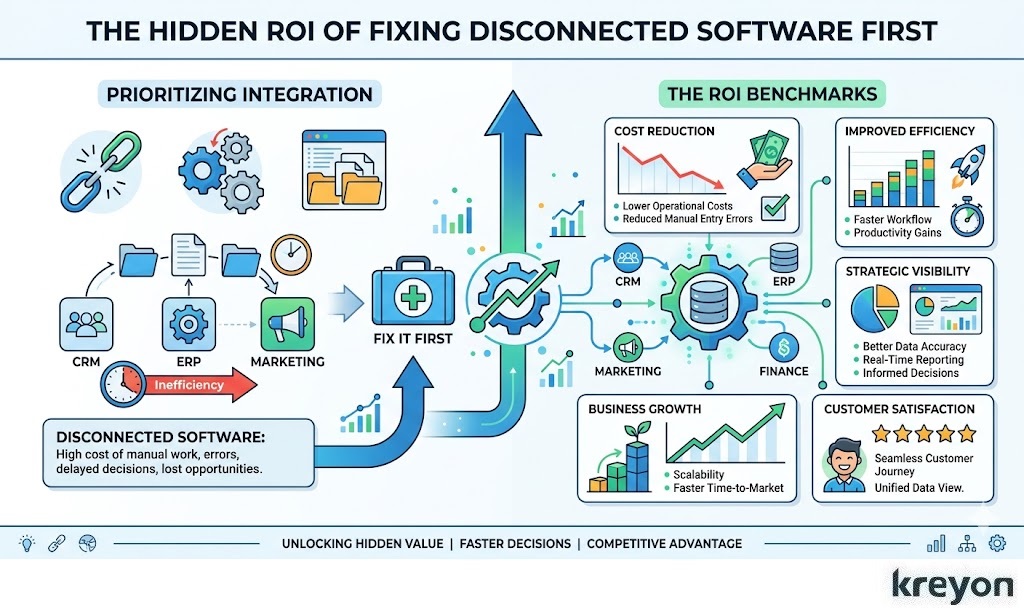
The Hidden ROI of Fixing Disconnected Software First
Most SMBs think integration is expensive. But the real cost is doing nothing.
Let’s break it down:
Without integration:
- Manual data entry costs hours daily
- Missed opportunities reduce revenue
- Teams waste time reconciling systems
- Decisions are delayed or wrong
With integration:
- Processes run automatically
- Teams focus on revenue-generating work
- Reporting becomes instant
- AI tools become effective
According to Deloitte, companies that invest in system integration see 20–30% improvements in operational efficiency within the first year. That’s not a marginal gain. That’s structural improvement.
How SMBs Can Fix Disconnected Software (Without Rebuilding Everything)
The good news? You don’t need to replace all your software. Most SMBs already have the right tools. They just don’t communicate.
Here’s a practical approach:
Step 1: Map Your Systems
List every tool your business uses:
- CRM
- Accounting
- Marketing
- Operations
- Communication
Step 2: Identify Data Flow Gaps
Where does data stop moving?
Where do humans manually intervene?
Step 3: Start with High-Impact Integrations
Focus on:
- Lead-to-sales pipeline
- Sales-to-invoice workflow
- Customer support automation
Step 4: Layer Automation After Integration
Once systems are connected, automate repetitive tasks.
This is exactly where Kreyon Systems help SMBs transition from disconnected tools to unified digital ecosystems.
Why AI Should Be the Second Step, Not the First
There is a growing misconception that AI is the starting point of digital transformation.
It’s not. AI is the acceleration layer, not the foundation.
If your systems are disconnected:
- AI will hallucinate or misinterpret data
- Automations will break
- Insights will be unreliable
If your systems are integrated:
- AI becomes a decision-support engine
- Workflows become autonomous
- Business intelligence becomes real-time
The sequence matters:
Integration → Automation → AI
Not the other way around.
Conclusion: Fix the Foundation Before You Scale the Intelligence
At its core, the problem of disconnected software is not a technology issue. It’s a clarity issue.
Businesses don’t fail because they lack tools. They fail because their tools don’t work together.
Before you invest in AI dashboards, chatbots, or automation platforms, take a hard look at your systems. If they don’t talk to each other, your AI strategy is built on sand.
Fix the integration first. Everything else becomes easier after that.
Kreyon Systems seamlessly integrates your ERP, CRM, SCM etc. with all your business tools to build unified & high-performing operations. For queries, please contact us.