
Using AI for Product Discovery for Mid to Large Sized Companies
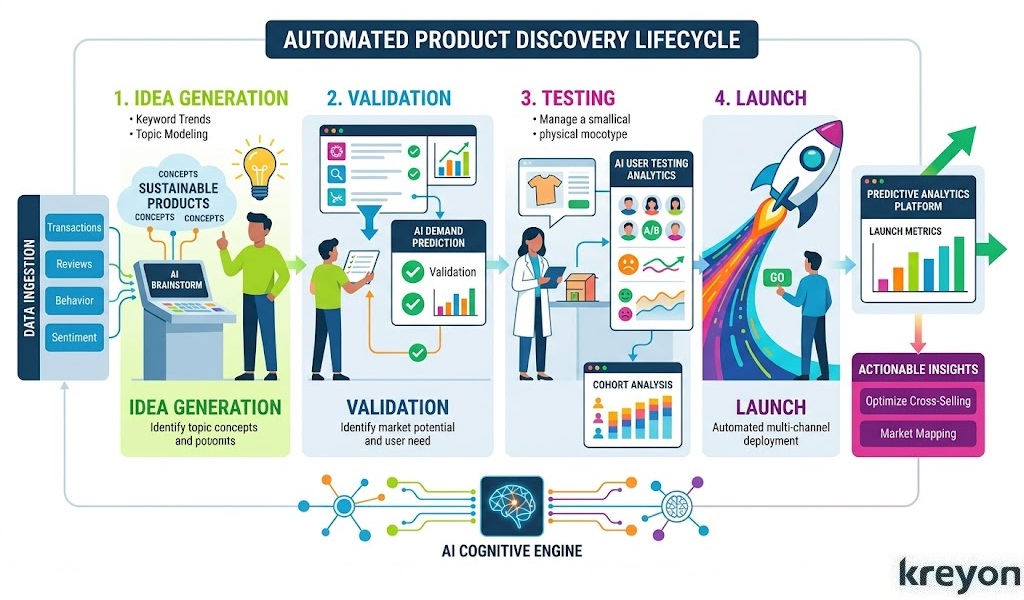
For decades, product discovery in large-scale enterprises has felt like trying to navigate a sprawling, ancient library without a catalog.
You know the “next big thing” is in there somewhere buried under customer feedback logs, churn data, and market shifts. But by the time your team unearths it, the market has already moved on.
The traditional discovery phase is often the most expensive bottleneck in the product lifecycle. But we are seeing a fundamental shift.
The move toward AI for product discovery automation isn’t just about speed; it’s about moving from “gut-feel” guesswork to a high-fidelity, data-driven map of what your customers actually need.
Why Enterprise Discovery is Breaking Down
In mid to large-sized companies, the sheer volume of data is a double-edged sword. You have more insights than a startup, yet you’re often slower to act. Why?
Because manual synthesis doesn’t scale. When you have 50,000 active users, a product manager cannot realistically read every support ticket, analyze every heat map, and track every competitor’s feature release.
This is where AI for product discovery automation steps in as a cognitive partner. It’s not replacing the product manager; it’s liberating them from the “drudge work” of data sorting so they can focus on what humans do best: empathy and strategic vision.
Scaling Insights: AI for Product Discovery Automation
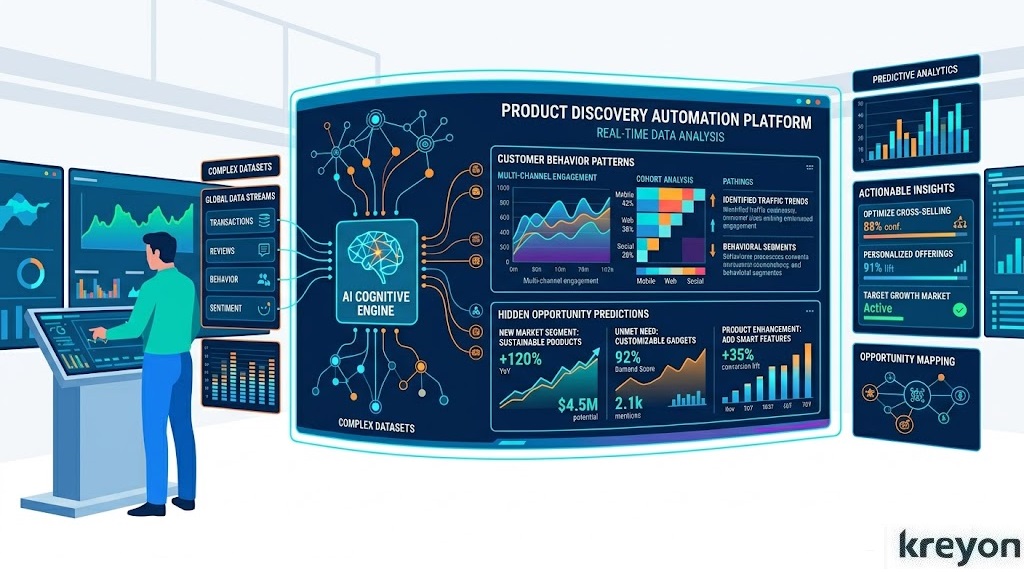
AI doesn’t just collect data. It connects the dots. Herein lies the value of using AI for product discovery.
For example, instead of simply telling you what customers bought last quarter, AI can highlight why they bought it, what they’re likely to want next, & where unmet needs are hiding. That’s the difference between reactive and proactive product strategy.
The core of modern discovery lies in pattern recognition. Traditional tools show you what happened (descriptive analytics), but AI shows you why it might happen again (predictive insights).
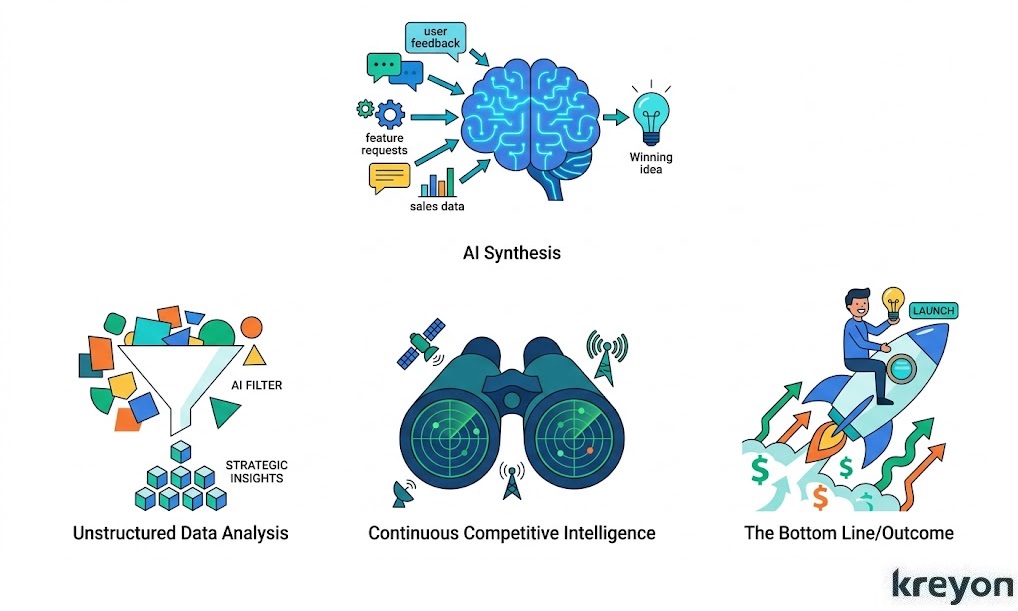
For a large enterprise, the automation of these insights functions in three distinct layers:
-
Unstructured Data Synthesis: AI can ingest thousands of “messy” data points, sales calls, Reddit threads, and CSAT scores—and cluster them into coherent “problem statements.”
-
Continuous Competitive Intelligence: Instead of a quarterly manual review, automated agents monitor the landscape in real-time, flagging shifts in competitor pricing or feature sets the moment they happen.
-
Hypothesis Validation: AI models can simulate user responses based on historical behavior, allowing teams to “pre-test” concepts before writing a single line of code.
Overcoming Size with Automation
Large companies suffer from the administrative friction that slows down innovation. AI for product discovery automation acts as a friction-reducer.
By automating the evidence-gathering phase, you cut down the weeks spent in committee meetings trying to justify a product pivot. When the data is synthesized and presented with high confidence levels by an AI model, the path to “Yes” becomes significantly shorter.
Consider a mid-sized SaaS company struggling with churn. Traditionally, they might spend months interviewing customers.
With discovery automation, an AI layer can identify a specific friction point in the onboarding flow, one that is common across a specific sub-segment of users within hours.
AI doesn’t just tell you what customers are doing, it helps you understand behavior at a deeper level. Sentiment analysis, for instance, can scan thousands of reviews to uncover recurring frustrations or desires.
Implementation: Moving Beyond the Hype
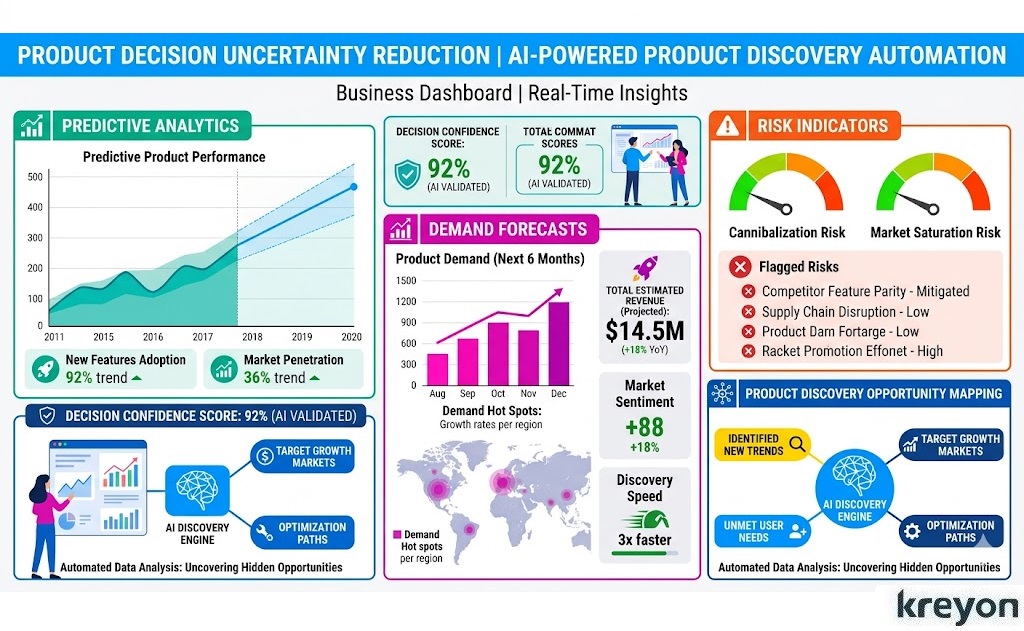
To successfully integrate AI for product discovery automation, leadership must treat it as a cultural shift, not just a software patch.
Adopting AI doesn’t have to mean a massive overhaul. In fact, the most successful companies start small and scale thoughtfully.
-
Audit Your Data Hygiene: AI is only as good as the meal you feed it. Ensure your CRM, support tools, and product analytics are talking to each other.
-
Use Case: Don’t try to solve everything at once. Focus on a specific challenge, like improving idea validation or understanding customer churn and build from there.
- Integration Complexity: Many large companies rely on legacy systems that don’t play nicely with modern AI tools. Look for flexible platforms or custom solutions that bridge the gap without requiring a full system overhaul.
-
The Human-in-the-Loop Requirement: Automation provides the what, but humans provide the context. An AI might find a pattern, but a product leader decides if that pattern aligns with the company’s 5-year mission.
-
Iterative Adoption: Start by automating one narrow slice of discovery, perhaps sentiment analysis of user feedback, before moving to full-scale predictive modeling.
Why Mid to Large Companies Are Leaning Into AI for Product Discovery Automation
 Large organizations have one big advantage: data. They also have one big problem: too much data.
That’s where AI shines.
1. Faster Time to Market
Traditional product discovery cycles can take months. By the time insights are gathered and analyzed, the opportunity may have already passed. AI compresses that timeline dramatically, helping teams move from idea to validation in weeks—or even days.
2. Sharper Customer Insights
AI reveals the story behind customer actions. Sentiment analysis can comb through vast review data to expose recurring frustrations and desires that would otherwise go unnoticed.
3. Smarter Risk Management
Launching a product always carries risk. But AI can simulate outcomes, forecast demand, and flag potential issues early. It’s not about eliminating risk, it’s about making it more predictable.
4. Better Alignment Across Teams
When everyone from product managers to marketing teams is working from the same data-driven insights, alignment becomes much easier. AI creates a shared source of truth.
The Bottom Line: Discovery as a Competitive Moat
The companies that win in the next decade won’t be the ones with the biggest budgets, but the ones with the shortest feedback loops.
By leveraging AI for product discovery automation, mid to large-sized enterprises can finally shed the weight of their own complexity.
The goal isn’t just to build products faster; it’s to ensure that when you finally launch, you’re launching exactly what the market was waiting for.
Kreyon Systems helps companies use AI to innovate faster, reduce risk, & make smarter decisions. Unlock growth with AI for Product Discovery Automation. For queries, please contact us.