
Business Automation ROI for Improving Business Performance: ROI Insights for CXOs
Walk into any executive meeting today, and the most pressing question is no longer “Should we automate?” The conversation has shifted to: “How quickly can automation deliver measurable returns? How large will they be? And how can we scale them strategically?”
Automation has moved from IT departments into the core of business strategy. Companies leveraging it effectively are not just faster—they operate smarter, scale more efficiently, and outperform competitors across cost efficiency, operational agility, and customer satisfaction.
Yet, despite the growing adoption, many leadership teams still underestimate the full financial, operational, and strategic value automation can deliver.
In this article, we explore Business Automation ROI comprehensively: what it is, how to calculate it, real-world results from leading organizations, and actionable insights for CXOs.
Why Business Automation ROI Should Be on Every CXO’s Agenda
Automation today is far beyond simple workflow scripts or robotic process automation (RPA). Modern enterprises deploy:
-
AI-powered decision-making: Systems that autonomously handle routine decisions, freeing humans for complex judgment calls.
-
Low-code orchestration platforms: Rapidly deployable automation workflows without extensive development cycles.
-
Predictive analytics and process intelligence: Identify bottlenecks and optimize operations proactively.
-
Autonomous operations: Certain processes now run completely without human oversight.
-
Cloud-native automation suites: Fully scalable, integrated, and secure for enterprise needs.
The critical question remains: Can automation deliver clear, measurable ROI in a consistent, sustainable way?
Research from McKinsey, Deloitte, and Accenture confirms that organizations scaling automation across multiple business functions achieve:
-
25–50% reduction in operational costs
-
50–200% faster process cycles
-
Significant improvements in accuracy, compliance, and customer satisfaction
Automation isn’t just a tech upgrade, it’s a strategic lever for growth, profitability, and competitive differentiation.
Understanding Business Automation ROI: Beyond Cost Savings
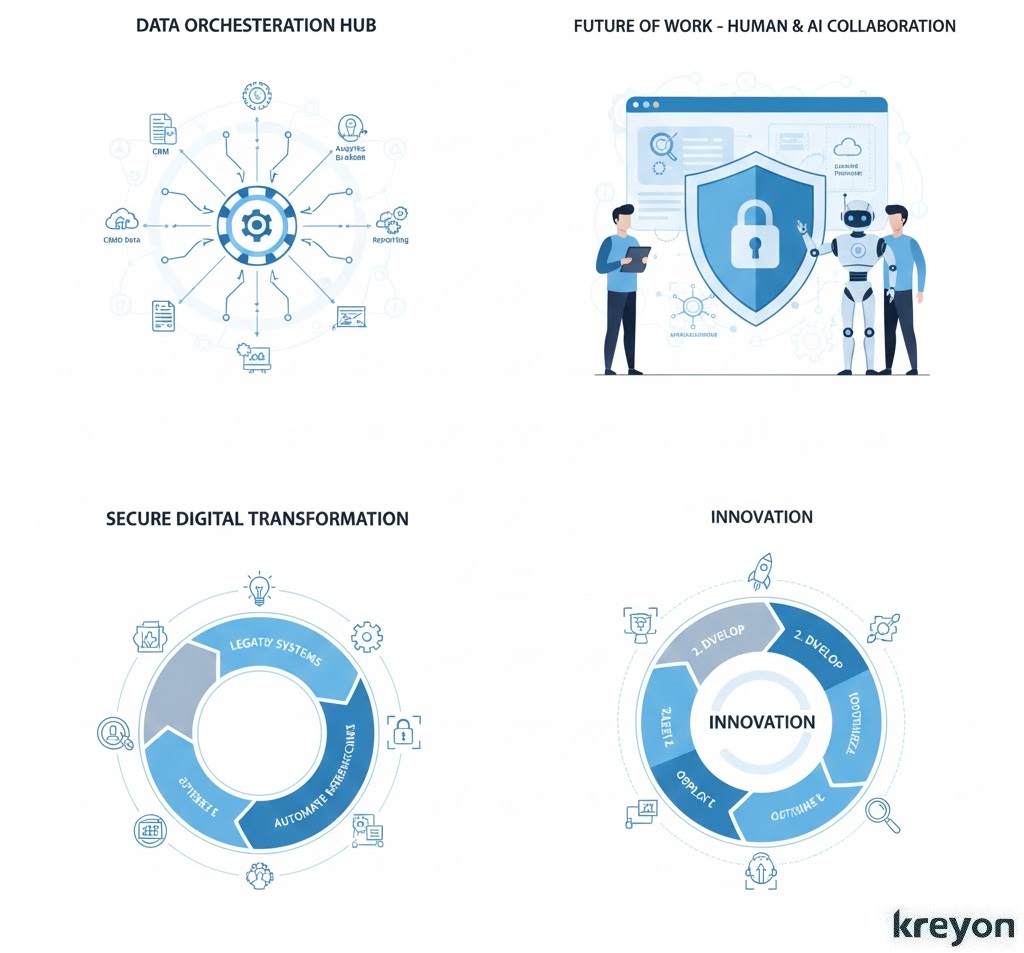
Many executives equate automation ROI with labor savings. The reality is far richer. Automation impacts multiple dimensions of value creation:
-
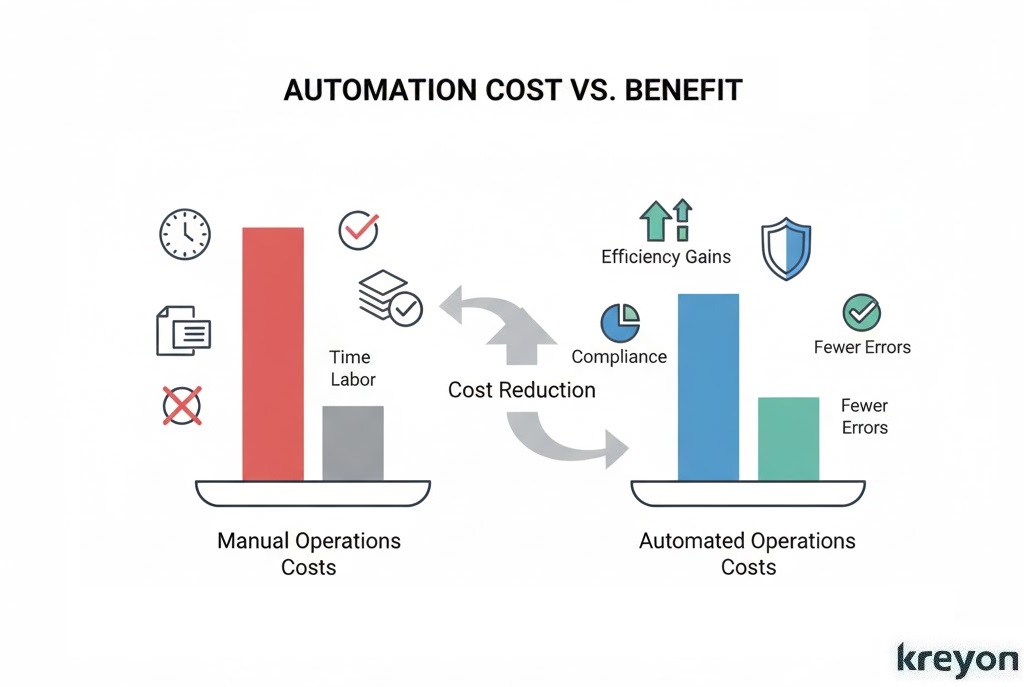
Cost Reduction: Minimizes errors, reduces rework, and decreases dependency on manual labor.
-
Throughput Increase: Processes run faster with fewer bottlenecks.
-
Revenue Enablement: Automation enables faster delivery, reduced churn, and increased sales conversion.
-
Quality Improvement: Consistency, compliance, and standardization improve.
-
Scalability: Expand operations without a proportional increase in headcount.
-
Employee Uplift: Staff focus on strategic, high-value tasks, boosting innovation and engagement.
Automation transforms not just efficiency but the way organizations create and capture value.
The Three Pillars of Business Automation ROI
To evaluate ROI effectively, CXOs should consider financial, operational, and strategic impact.
1. Financial ROI
Financial ROI is the most tangible and easiest to communicate to boards. Key metrics include:
-
Reduced cost per transaction
-
Labor hours saved
-
Fewer errors and less rework
-
Avoided penalties due to compliance or regulatory issues
For example, McKinsey estimates that well-executed automation initiatives can deliver 3–5x ROI within 12–18 months. For finance teams, automating invoice processing not only reduces late fees but also accelerates cash flow and improves working capital management.
2. Operational ROI
Operational ROI focuses on efficiency and predictability:
-
Cycle-Time Reduction: Faster completion of critical business processes.
-
SLA Adherence: Consistent performance against service-level agreements.
-
Standardized Workflows: Less variability and higher quality output.
-
Resource Optimization: Employees can concentrate on strategic tasks.
-
Increased Visibility: Real-time dashboards allow leaders to make informed decisions.
Operational ROI compounds over time as automation expands to multiple business functions.
3. Strategic ROI
Strategic ROI reflects automation’s contribution to competitive advantage:
-
Faster Decision-Making: Real-time insights and predictive analytics guide executive choices.
-
Improved Customer Experience: Automation accelerates service and reduces errors.
-
Scalability During Growth: Add capacity without proportional investment in labor.
-
New Revenue Opportunities: Automation enables innovative offerings and faster go-to-market.
-
Enhanced Innovation Capacity: Staff can focus on ideation, design, and strategic initiatives.
Boards and investors increasingly expect leaders to quantify these strategic gains, not just cost savings.
Measuring Business Automation ROI: A Step-by-Step Framework for CXOs
Many organizations fail to realize the full value of automation because ROI isn’t measured effectively. Here’s a practical framework:
Step 1: Identify High-Impact Use Cases
Target repetitive, high-volume, error-prone processes in:
-
Finance: Accounts payable/receivable, reconciliations, audit reporting
-
HR: Employee onboarding, payroll, benefits administration
-
Sales: CRM automation, lead scoring, pipeline reporting
-
Operations: Procurement, logistics, order management
-
IT: Monitoring, ticket triage, password resets
Selecting use cases with predictable ROI ensures early wins and stakeholder buy-in.
Step 2: Establish Baseline Metrics
Measure current performance to understand the starting point:
-
Average processing times
-
Manual employee & labor hours
-
Error and rework rates
-
Customer satisfaction
-
Compliance adherence
A clear baseline is essential to quantify the impact of automation accurately.
Step 3: Calculate ROI
Use the classic formula:
ROI = (Annual Benefit – Total Cost) ÷ Total Cost × 100
Annual benefits can include:
-
Labor savings
-
Revenue protection or acceleration
-
Reduced errors and rework
-
Avoided compliance penalties
For example, automating procurement can save thousands of hours annually, reduce late payments, and even negotiate better supplier terms.
Step 4: Track Real-Time Performance
Automation is iterative. Track outcomes continuously:
-
Time savings
-
Cost reductions
-
SLA adherence
-
Exception rates
-
User adoption
Leading organizations use automation dashboards for continuous monitoring and expansion.
Business Automation ROI in Action: Expanded Case Studies
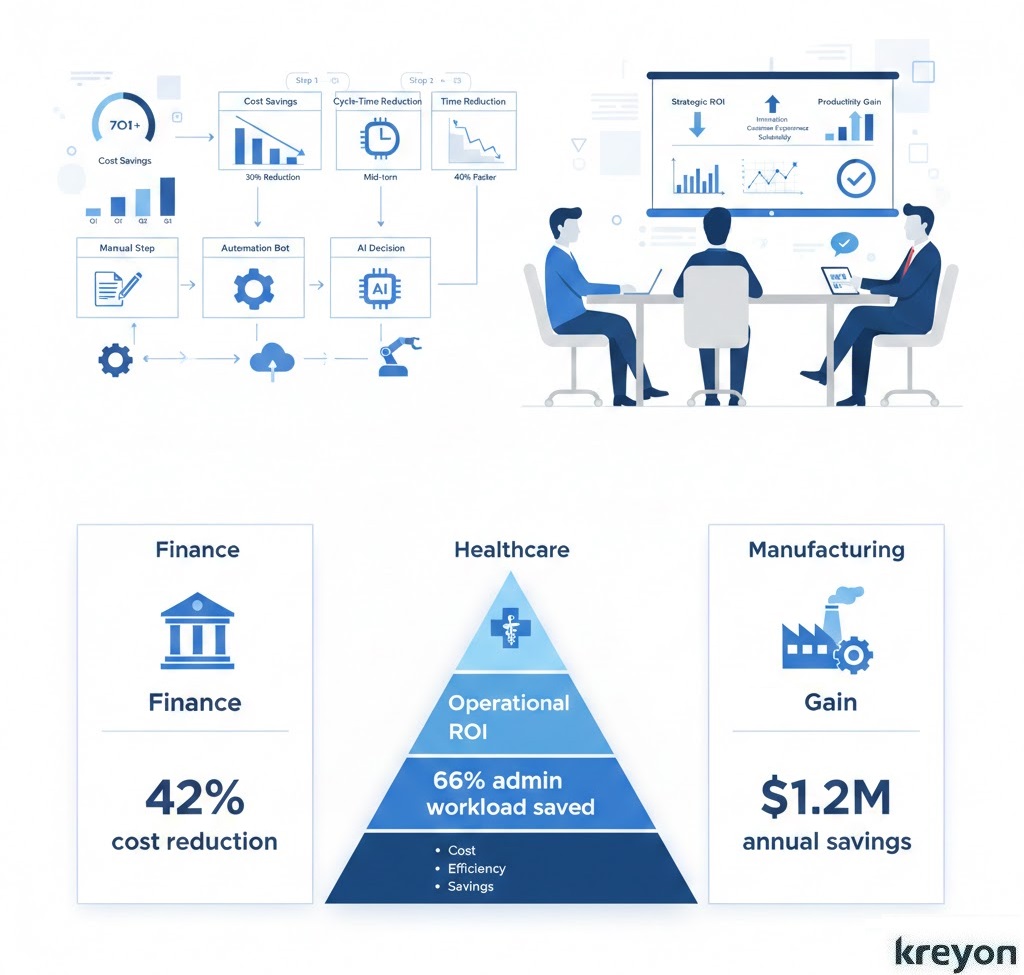
Case Study 1: Financial Services: 42% Operational Cost Reduction
A mid-sized NBFC automated:
-
Loan processing
-
Credit checks
-
Compliance reporting
Results:
-
42% reduction in operational costs
-
3x faster processing cycles
-
97% error elimination
-
Zero compliance delays
Key insight: Combining RPA with AI-driven decisioning enabled rapid approvals without increasing risk exposure.
Case Study 2: Healthcare: 66% Reduction in Administrative Workload
A healthcare provider automated claims processing and EMR updates.
Results:
-
66% reduction in administrative workload
-
400+ hours/month saved
-
99% accuracy in claims
-
35% faster patient response times
Key insight: Automation freed clinical staff to focus on patient care, improving outcomes and patient satisfaction.
Case Study 3: Manufacturing: $1.2M Annual Savings
A global manufacturer automated:
-
Inventory management
-
Production scheduling
-
Supplier coordination
Results:
-
$1.2M annual savings
-
Real-time supply chain visibility
-
28% reduction in out-of-stock events
Key insight: Automation of supply chain processes enabled proactive management of production bottlenecks and reduced downtime.
Industry-Specific Benchmarks for CXOs
-
Financial Services: 30–50% reduction in processing costs, 2–3x faster transaction cycles
-
Healthcare: 50–70% decrease in administrative workload, 20–40% faster patient claim processing
-
Manufacturing: $1M–$5M annual savings on logistics and operations, 20–30% reduction in errors or delays
-
Retail & eCommerce: 15–25% increase in fulfillment speed, 10–20% reduction in returns due to automation
How Automation ROI Supports CXO Decision-Making
Automation impacts each member of the C-suite differently:
-
CEOs: Margin growth, scalable business models, higher enterprise valuation
-
CFOs: Predictable ROI, reduced operational expenditure, improved reporting
-
CIOs/CTOs: Modernized architecture, reduced reliance on legacy systems, better security
-
CHROs: Workforce optimization, higher productivity, more time for strategic initiatives
When automation becomes a shared enterprise strategy, ROI compounds across departments.
Emerging Trends That Will Redefine Automation ROI
-
Autonomous Operations: AI-driven systems manage entire processes end-to-end
-
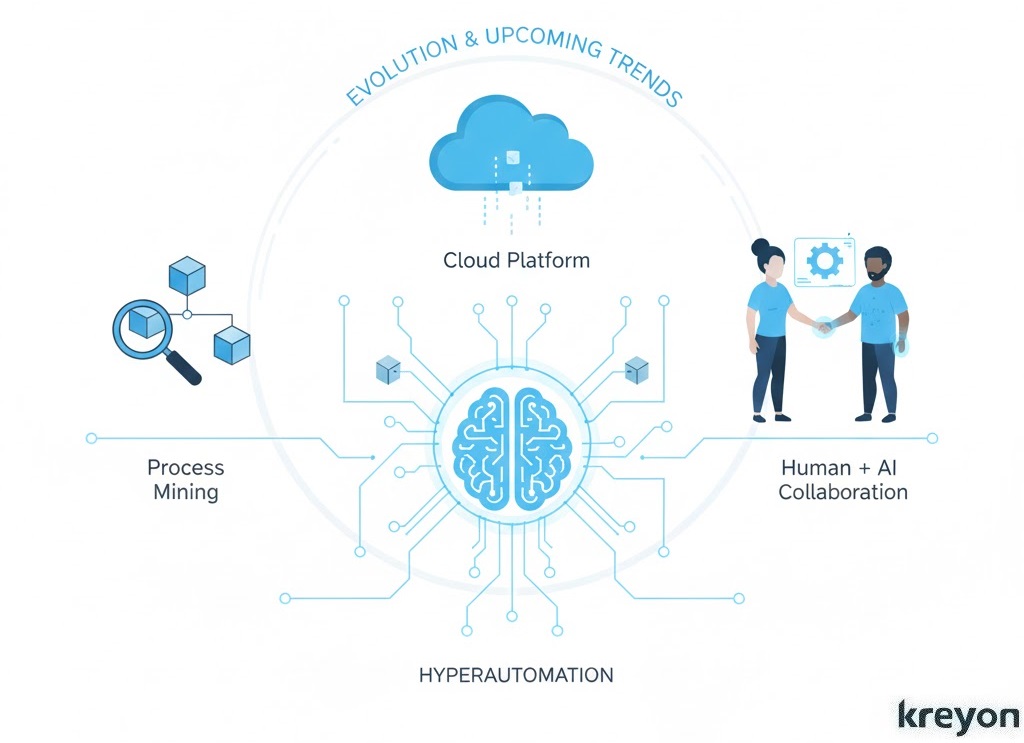
Hyperautomation Ecosystems: Integration of RPA, AI, analytics, and low-code for enterprise-wide efficiency
-
Process Intelligence: Continuous monitoring and predictive analytics optimize processes in real-time
-
AI-Augmented Decisioning: Enhanced decision-making with real-time insights and predictive forecasts
-
Workforce Redesign: Staff focus on strategic, creative, and relational work rather than repetitive tasks
Automation is not about replacing humans, it’s about freeing them to add more strategic value.
Conclusion: Automation is a Strategic Imperative
Business Automation ROI is not just a technical metric, it’s a leadership metric, a growth metric, and a competitive advantage metric. Companies investing strategically in automation see:
-
Higher profitability
-
Operational resilience
-
Faster customer response
-
Scalable processes
-
Smarter, data-driven decisions
The mandate for CXOs is clear: treat automation as a strategic investment, not just an operational expense. Those who act now will define the next era of competitive advantage; those who wait risk falling irreversibly behind.
Kreyon Systems engineers business performance through results-first automation. Streamline your operations and scale your business at speed. If you have queries, please contact us.