
AI Document Automation: Building an End-to-End AI Document Intelligence System

The modern enterprise is drowning in dark data. Every day, thousands of invoices, contracts, and shipping manifests flood into organizations, only to be buried in digital filing cabinets.
For years, we relied on basic Optical Character Recognition (OCR) to “read” these documents, but reading isn’t the same as understanding.
This is where AI Document Automation shifts from a back-office utility to a boardroom priority. We aren’t just talking about scanning PDFs anymore; we are talking about building an end-to-end AI Document Intelligence System that thinks, categorizes, and acts.
Invoices waiting to be processed. Contracts stalled in approval cycles. Compliance files buried in fragmented systems. These are not edge cases, they are the operational backbone of most organizations. And in many cases, they remain deeply manual.
This is where AI Document Automation emerges not as a marginal improvement, but as a structural shift.
At Kreyon Systems, we’ve observed a consistent pattern across industries: organizations don’t struggle because they lack data, they struggle because their data is trapped inside documents. Unlocking that data, and turning it into action, is where the real transformation begins.
Beyond OCR: What AI Document Automation Actually Means
Many organizations believe they’ve addressed document inefficiencies by implementing OCR. While OCR converts images into machine-readable text, it stops short of understanding.
And in business, understanding is everything.
AI Document Automation extends far beyond extraction. It introduces context, reasoning, and decision-making into document workflows.
A modern system is capable of:
- Identifying document types without predefined templates
- Extracting relevant fields despite format variations
- Interpreting meaning (e.g., contract clauses, payment terms)
- Triggering downstream actions automatically
The distinction is subtle but critical:
Traditional systems digitize documents.
AI Document Automation operationalizes them.
This shift from digitization to intelligence is what separates incremental improvement from exponential impact.
Why AI Document Automation Is Becoming a Strategic Imperative
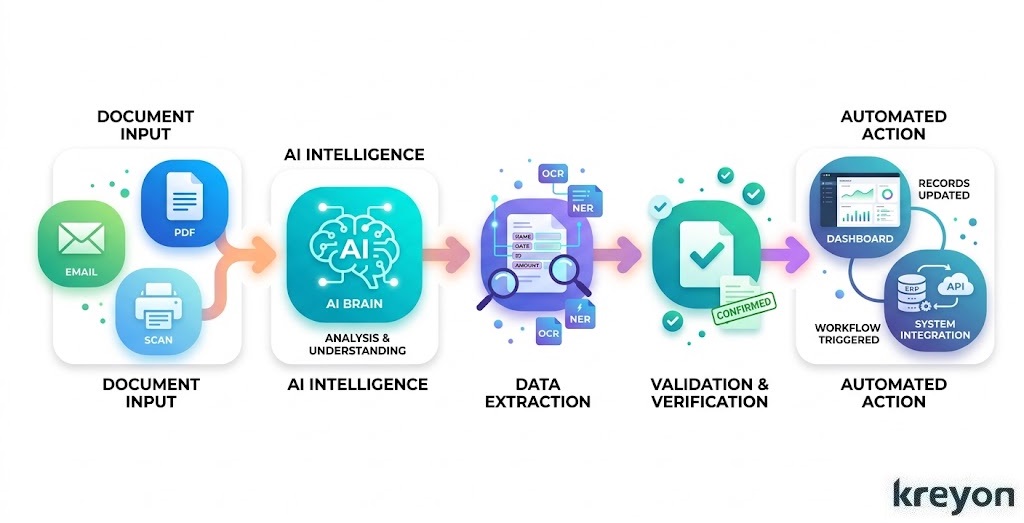
The case for AI Document Automation is no longer theoretical. It is economic.
Consider the typical enterprise workflow:
- Legal teams review contracts line by line
- Operations teams reconcile data across systems
- Finance teams manually process invoices
Each of these processes is:
- Time-intensive
- Error-prone
- Difficult to scale
As transaction volumes grow, organizations face a choice is either hire more people or redesign the system.
Forward-looking companies are choosing the latter.
The Measurable Impact
Organizations implementing end-to-end AI document systems report:
- Up to 80% reduction in processing time
- Significant improvements in data accuracy
- Faster cycle times across operations
- Enhanced compliance and auditability
But perhaps the most important outcome is less tangible:
A shift from reactive operations to proactive decision-making
Designing an End-to-End AI Document Automation System
At Kreyon Systems, we approach AI Document Automation not as a tool, but as a system of intelligence. Building such a system requires thinking in layers, each one contributing to a seamless flow from document to decision.
1. Intelligent Ingestion: Creating a Unified Entry Point
Documents enter organizations through a variety of channels like emails, uploads, APIs, scanned inputs etc. The first challenge is not processing them, but capturing them consistently.
An effective ingestion layer:
- Aggregates documents from all sources
- Normalizes formats for downstream processing
- Ensures no data is lost at entry
This layer is often underestimated, yet it determines the reliability of the entire system.
2. Context-Aware Extraction: Turning Unstructured Data into Structured Insight
Once ingested, documents must be interpreted.
Unlike rule-based systems, AI-driven extraction models are designed to handle variability. They learn from patterns rather than relying on rigid templates.
For example, two invoices may differ significantly in layout, yet contain the same essential information. A robust AI model identifies these patterns and extracts:
- Vendor details
- Invoice amounts
- Dates and terms
- Line-item data
Over time, the system improves, adapting to new formats without manual reconfiguration.
3. Validation and Trust Layer: Ensuring Data Integrity
Automation without trust fails quickly.
Data extracted from documents must be validated against business rules and external systems. This includes:
- Cross-checking totals and calculations
- Verifying vendor or customer records
- Ensuring compliance with regulatory standards
The emphasis on this layer heavily because it bridges the gap between automation and adoption. When stakeholders trust the output, automation scales.
4. Decision Automation: Moving Beyond Processing
Most organizations stop at extraction. High-performing organizations go further.
They embed decision logic directly into workflows.
This enables:
- Automatic approval of low-risk transactions
- Intelligent routing of exceptions
- Real-time updates to ERP and CRM systems
- Triggering downstream actions such as payments or notifications
At this stage, AI Document Automation evolves into what we call an autonomous workflow system, one that not only processes information but acts on it.
5. Continuous Learning: Building a Data Moat
Every document processed contributes to a growing dataset. This creates a feedback loop:
- More data → better models
- Better models → higher accuracy
- Higher accuracy → increased adoption
Over time, this loop becomes a competitive advantage that is difficult to replicate.
Organizations that invest early in AI Document Automation are not just improving efficiency, they are building proprietary intelligence systems.
The Cost of Inaction: What Most Leaders Overlook
It is easy to evaluate AI initiatives based on implementation cost. It is harder, but more important, to evaluate the cost of inaction.
Without AI Document Automation:
- Processing delays accumulate
- Errors propagate across systems
- Decision-making slows down
- Operational costs scale linearly with growth
These costs are rarely visible in isolation, but collectively they create significant drag on the organization.
The question, therefore, is not whether automation delivers ROI.
It is whether the organization can afford to operate without it.
Document Automation Delivers Value For Applications
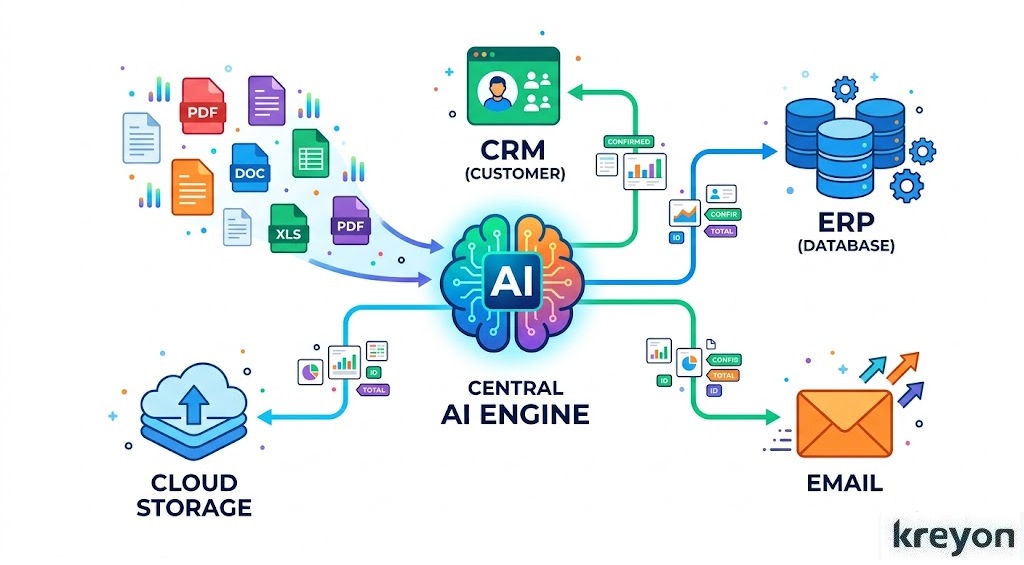
While the underlying technology is consistent, its applications vary across industries.
Finance and Accounting
- Automated invoice processing
- Expense reconciliation
- Audit-ready documentation
Legal and Compliance
- Contract analysis
- Clause extraction
- Regulatory validation
Healthcare Operations
- Patient record processing
- Claims management
- Compliance documentation
Logistics and Supply Chain
- Bill of lading processing
- Shipment documentation
- Vendor coordination
Across these domains, the pattern remains consistent:
Reduce manual effort
Increase speed
Improve decision quality
Implementation Challenges and a Practical Path Forward
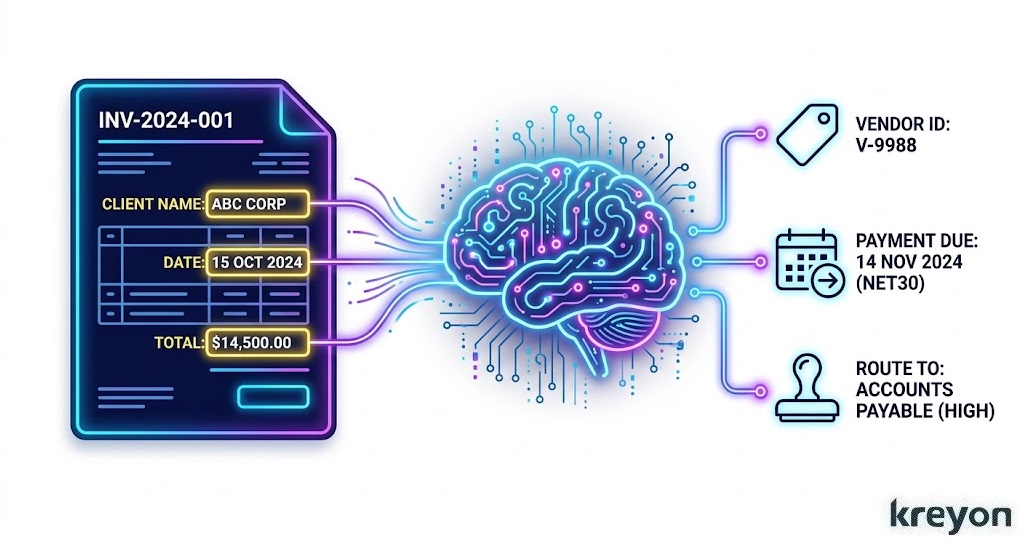
Despite its potential, AI Document Automation requires thoughtful implementation.
You don’t need to automate every department on day one. In fact, you shouldn’t. The most successful implementations follow a “Land and Expand” strategy:
1. The Anchor of Legacy Systems
Most enterprises aren’t “digital natives.” They operate on a patchwork of legacy infrastructure, mainframes, on-premise servers, and aging ERPs, that were built long before the era of machine learning.
The Conflict: AI requires high-speed data flow and modern APIs to function in real-time. Legacy systems often store data in “silos” or use batch processing (updating once a day), which creates a latency gap that can make AI insights obsolete by the time they are generated.
The Solution: Don’t “rip and replace.” Instead, implement a non-invasive AI layer. This acts as an intelligent bridge that sits atop your existing systems, extracting and processing document data without requiring a total architectural overhaul.
2. Fragmented Data Sources
An AI is only as smart as the data it can access. In many organizations, document data is scattered across email inboxes, cloud storage, physical filing cabinets, and disparate departmental databases.
The Conflict: When data is fragmented, the AI lacks a “single source of truth.” It might see an invoice in one system but miss the corresponding contract in another, leading to incomplete analysis or “hallucinations” where the AI fills in gaps with incorrect assumptions.
The Solution: Prioritize Master Data Management (MDM) and centralized data ingestion. Before scaling your AI, create a unified “landing zone” where all documents are normalized and indexed, regardless of their origin.
3. Organizational Resistance
The most sophisticated AI system in the world will fail if the people meant to use it don’t trust it, or worse, fear it.
The Conflict: Resistance usually stems from two places: fear of job displacement and a lack of “transparency.” If a claims adjuster doesn’t understand why the AI flagged a document as fraudulent, they are likely to ignore the tool and return to manual methods.
The Solution: Pivot from “Automation” to “Augmentation.” Communicate clearly that the AI’s role is to handle the “drudge work” of data entry, allowing humans to focus on high-level decision-making. Incorporating Explainable AI (XAI), where the system shows its reasoning and is the fastest way to build internal trust.
4. Overambitious Initial Scope
The “Boil the Ocean” syndrome is a common pitfall. Organizations often try to automate every document type across every department in a single phase.
The Conflict: High complexity leads to high failure rates. When you try to solve ten complex problems at once, you dilute your resources and increase the likelihood of technical “debt” and stakeholder burnout. If the first big project fails, it can sour the organization’s appetite for AI for years.
The Solution: The “Land and Expand” approach. Identify one high-volume, high-friction use case, such as Accounts Payable or shipping logs and automate it successfully. This creates a “quick win” that proves ROI and provides a blueprint for scaling into other departments
Don’t just track “time saved.” Track “insights gained.” How many billing errors did the AI catch that a tired human might have missed.
Transformation does not require a big bang. It requires consistent, compounding improvements.
The Future: From Documents to Autonomous Operations
Looking ahead, the trajectory is clear.
Documents will no longer serve as static records. They will become dynamic inputs into intelligent systems.
AI Document Automation will evolve into:
- Fully autonomous workflows
- Predictive decision engines
- Real-time operational intelligence
Organizations that embrace this shift will not simply operate more efficiently, they will operate differently.
Conclusion: Designing for Outcomes, Not Tools
AI Document Automation is often framed as a productivity tool. In reality, it is a strategic capability.
When implemented effectively, it transforms:
- Documents into data
- Data into decisions
- Decisions into outcomes
At Kreyon Systems, we believe the future of enterprise operations lies in systems that think, learn, and act. If you have any queries, please contact us.